Faced with melting polar ice caps and worsening droughts, climate experts at a massive United Nations conference Monday urged quick action toward a new international pact stemming an increasingly destructive rise in world temperatures.
A key goal of the two-week conference, which opened with delegates from nearly 190 countries in attendance, will be to draw a skeptical United States into an agreement to cut emissions of carbon dioxide and other so-called greenhouse gases.
While the U.S. delegation declared it would not be a "roadblock" to a new agreement, Washington remains opposed to steps many other countries support, such as mandatory emissions cuts by rich nations and a target for limiting the rise in global temperatures.
 The American position suffered a blow Monday when the new Australian prime minister signed papers to ratify the Kyoto Protocol climate pact. The move leaves the U.S. the world's top emitter of greenhouse gases as the sole industrial power not to have joined.
Conference leaders urged delegates to move quickly to combat climate change.
"The eyes of the world are upon you. There is a huge responsibility for Bali to deliver," said Yvo de Boer, the executive secretary of the conference. "The world now expects a quantum leap forward."
The conference kicked off amid growing global momentum for dramatic action to stop rising temperatures that scientists say could lead to swamping of coastal areas and islands by higher oceans, the wiping out of species, economic havoc and a spike in natural disasters such as storms, fires and droughts.
The Bali meeting will be the first major conference of its kind since former Vice President Al Gore due to arrive next week and a United Nations scientific council won the Nobel Peace Prize in October for their environmental work.
The immediate aim will be to launch negotiations toward a pact to replace the Kyoto Protocol when it expires in 2012, and set an agenda for the talks and a deadline. The United Nations says such an agreement should be concluded by 2009 in order to have a system in place in time.
Among the most contentious issues ahead will be whether emission cuts should be mandatory or voluntary. Also to be tackled will be to what extent up-and-coming economies like China and India will have to rein in their skyrocketing emissions, and how to help the world's poorest countries adapt to a worsening climate. The American delegation was clearly on the defensive in Bali, presenting a statement detailing the ways the U.S. is fighting global warming without submitting to mandatory emissions targets.
"We're not here to be a roadblock," insisted Harlan L. Watson, the senior U.S. climate negotiator. "We're committed to a successful conclusion, and we're going to work very constructively to make that happen."
Confronted with the scientific reports of the past year, the Bush administration has signaled a willingness to play a larger role in the negotiations, and U.N. officials agree they must craft a post-Kyoto framework that Washington will go along with. Australia abandoned the anti-Kyoto alliance with the U.S. on Monday, when new Prime Minister Kevin Rudd signed the paperwork to ratify the pact. Delegates in Bali erupted in applause when Australia's delegate, Howard Bamsey, told the plenary that Canberra was jumping on board. Environmentalists at the conference cited what they saw as growing international momentum for tougher safeguards against global warming.
Even critics of the Bush administration pointed out that many individual states, such as California, were on the forefront of cutting emissions. "Despite the failure of the current president to take serious action on global warming, the political landscape in the United States is shifting dramatically in favor of mandatory limits on global warming pollution," said Alden Meyer of the Union of Concerned Scientists, citing upcoming action in the U.S. Congress. Trying to fend off charges that America is not doing enough, Bush said last week a final Energy Department report showed U.S. emissions of carbon dioxide, a leading greenhouse gas, declined by 1.5 percent last year while the economy grew.
A key goal of the two-week conference, which opened with delegates from nearly 190 countries in attendance, will be to draw a skeptical United States into an agreement to cut emissions of carbon dioxide and other so-called greenhouse gases.
While the U.S. delegation declared it would not be a "roadblock" to a new agreement, Washington remains opposed to steps many other countries support, such as mandatory emissions cuts by rich nations and a target for limiting the rise in global temperatures.
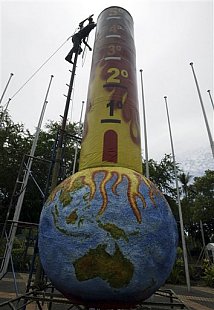 The American position suffered a blow Monday when the new Australian prime minister signed papers to ratify the Kyoto Protocol climate pact. The move leaves the U.S. the world's top emitter of greenhouse gases as the sole industrial power not to have joined.
Conference leaders urged delegates to move quickly to combat climate change.
"The eyes of the world are upon you. There is a huge responsibility for Bali to deliver," said Yvo de Boer, the executive secretary of the conference. "The world now expects a quantum leap forward."
The conference kicked off amid growing global momentum for dramatic action to stop rising temperatures that scientists say could lead to swamping of coastal areas and islands by higher oceans, the wiping out of species, economic havoc and a spike in natural disasters such as storms, fires and droughts.
The Bali meeting will be the first major conference of its kind since former Vice President Al Gore due to arrive next week and a United Nations scientific council won the Nobel Peace Prize in October for their environmental work.
The immediate aim will be to launch negotiations toward a pact to replace the Kyoto Protocol when it expires in 2012, and set an agenda for the talks and a deadline. The United Nations says such an agreement should be concluded by 2009 in order to have a system in place in time.
Among the most contentious issues ahead will be whether emission cuts should be mandatory or voluntary. Also to be tackled will be to what extent up-and-coming economies like China and India will have to rein in their skyrocketing emissions, and how to help the world's poorest countries adapt to a worsening climate. The American delegation was clearly on the defensive in Bali, presenting a statement detailing the ways the U.S. is fighting global warming without submitting to mandatory emissions targets.
"We're not here to be a roadblock," insisted Harlan L. Watson, the senior U.S. climate negotiator. "We're committed to a successful conclusion, and we're going to work very constructively to make that happen."
Confronted with the scientific reports of the past year, the Bush administration has signaled a willingness to play a larger role in the negotiations, and U.N. officials agree they must craft a post-Kyoto framework that Washington will go along with. Australia abandoned the anti-Kyoto alliance with the U.S. on Monday, when new Prime Minister Kevin Rudd signed the paperwork to ratify the pact. Delegates in Bali erupted in applause when Australia's delegate, Howard Bamsey, told the plenary that Canberra was jumping on board. Environmentalists at the conference cited what they saw as growing international momentum for tougher safeguards against global warming.
Even critics of the Bush administration pointed out that many individual states, such as California, were on the forefront of cutting emissions. "Despite the failure of the current president to take serious action on global warming, the political landscape in the United States is shifting dramatically in favor of mandatory limits on global warming pollution," said Alden Meyer of the Union of Concerned Scientists, citing upcoming action in the U.S. Congress. Trying to fend off charges that America is not doing enough, Bush said last week a final Energy Department report showed U.S. emissions of carbon dioxide, a leading greenhouse gas, declined by 1.5 percent last year while the economy grew.
Via: Associated Press|JOSEPH COLEMAN
Tags:


