Mostrando entradas con la etiqueta biodiesel. Mostrar todas las entradas

jueves, octubre 16, 2008

[BIOENERGY] Ethanol passes key transportation test

Houston pipeline operator Kinder Morgan Energy Partners signaled progress Wednesday in addressing a key hurdle to widespread distribution of renewable fuels in the U.S. The company said it completed a test in Florida that moved ethanol safely through an existing gasoline pipeline and is performing similar tests with biodiesel fuel blends.

The tests could be important for a U.S. biofuels industry that now transports fuel only by truck, rail car and barge, and will require more efficient transportation options as it grows.

Kinder Morgan and other pipeline companies are still in the early stages of testing. Huge investments will be needed if the companies decide to ready more assets to handle biofuels, and upgrades could take years.

Yet Kinder Morgan's moves suggest a willingness to explore the idea further.

Pipeline operators have been reluctant to run ethanol in pipelines because it absorbs debris, rust and water, can damage components and taint petroleum fuels that share the lines. They have balked at biodiesel because of uneven quality and a residue that can damage jet fuel if it follows biodiesel through a pipeline.

Kinder Morgan spent 18 months on the ethanol pipeline test in Florida and made more than $10 million in upgrades to a segment that connects Tampa and Orlando, said Jim Lelio, director of business development and national biofuels manager for the pipeline firm.

The segment was ideal for the study because it was fairly new, situated on flat land and carried only one product, gasoline, Lelio said. But upgrading it wasn't simple.

First, the company had to replace a number of parts, including seals, gaskets and other components. Then, it cleaned the pipeline with a device called a "pig" that ran through the line and scoured the interior with brushes and chemicals.

Finally, Kinder Morgan ran a 5,000-barrel batch of ethanol through the pipeline earlier this month with good results, Lelio said.

The company is still modifying the pipeline but expects to be transporting ethanol for customers by mid-November.

Lelio said the company will consider upgrades to other pipelines in its portfolio, depending upon customer demand and the ability to maintain the operational integrity of the pipelines.

New energy legislation calls for blending 36 billion gallons of biofuels a year into the nation's fuel supply by 2022, five times the current level, to help reduce dependence on oil.

While most of that will be ethanol, the law also requires blending of 500 million gallons of biodiesel a year by 2009.

Biodiesel is chiefly made from vegetable oil in the United States and is often blended at low levels with petroleum diesel. U.S. ethanol, usually made from corn, typically is blended with gasoline to stretch fuel supplies and help curb tailpipe emissions in cities with the dirtiest air, including Houston.

Critics have charged that production of biofuels has strained food supplies globally, hurt the environment and received excessive government subsidies.

But the ethanol industry's leading trade group, the Renewable Fuels Association, praised Kinder Morgan on Wednesday for demonstrating that "any technical challenges that may exist with the transport of ethanol through pipelines can be overcome."

As the ethanol industry grows, it may need to ship ethanol via pipelines, group spokesman Matt Hartwig said, and "Kinder Morgan's success goes a long way in proving that can be done."

Elsewhere, Kinder Morgan is testing biodiesel transportation in its Plantation pipeline from Collins, Miss., to Spartanburg, S.C. It is preparing for tests in Oregon, where a new biodiesel mandate will take effect soon.

Steve Howell, technical director for the National Biodiesel Board, an industry trade group, said it is no coincidence the tests were announced after national fuel standards were released this month for certain biodiesel blends.

"That was one of the key factors in a lot of the pipeline companies' reluctance before," he said.

While there are other technical factors to work out, he said, his group is assisting with other upcoming tests.

"We don't see it as necessary to be viable," Howell said of transporting biodiesel by pipeline. "But we think we can be more viable with it."


Source: Houston Chronicle| By BRETT CLANTON


Found this post useful? Consider subscribing to
.

miércoles, mayo 07, 2008

BRASIL: The brazilian government rejects biofuels criticism

BRASIL: The brazilian goverment rejects biofuels criticismThe Brazilian president has rejected criticism that his country's production of biofuels has forced a surge in global food prices and harms the environment. Luiz Inacio Lula da Silva accused critics of being driven by economic and political interests, and failing to highlight soaring oil prices and increased demand as a factor in pushing up food production costs.

"Don't tell me, for the love of God, that food is expensive because of biodiesel," he told reporters.

"Food is expensive because the world wasn't prepared to see millions of Chinese, Indians, Africans, Brazilians and Latin Americans eat. We want to discuss this not with passion but rationality and not from the European point of view."

Lula made his comments following a week of protests in Brazil and Europe against the fuels made from food crops and their supposed environmental and social consequences.

This week, the EU's environmental chief, Stavros Dimas, said that biofuels, which Brazil hopes to export to the EU, must now meet social and environmental conditions, and that "the issue of sustainabilty criteria is of crucial importance."

Scientists from the European Environment Agency urged the 27-nation bloc to drop its 10% biofuel target for road transport fuels.

Lula rebuffed accusations by Jean Ziegler, the UN's special rapporteur for the right to food, that biofuels were a "crime against humanity".

"The real crime against humanity is to discredit biofuels a priori and condemn food-starved and energy-starved countries to dependence and insecurity," Lula said.

Some of Brazil's neighbours, led by oil-rich Venezuela, warned this week that biofuels could increase malnutrition in Latin America. Lula said he was "shocked" that biofuel critics failed to mention the impact that high oil prices had on food production costs.

"It's always easier to hide economic and political interests behind supposed social and environmental interests," he said.

The growing criticism has placed Brasil at the centre of the global biofuels debate. The country has enjoyed an agricultural export boom, and has become the world's largest exporter of ethanol, which is derived from sugar cane. Critics say the increased production of crops for ethanol and biodiesel, which is derived from oil seeds, competes for land with food crops, and is pushing cattle ranchers and farmers further north in Brasil, contributing to the destruction of the Amazon rainforest.

But the Brazilian government has argued that it has plenty of unused land to plant crops for biofuels and that current production was still too small to affect food prices.

Source: The Guardian| by Anil Dawar


Found this post useful? Consider subscribing to
.

lunes, febrero 25, 2008

THE AMERICAS: Global Clean Energy Holdings Tests Crude Jatropha Oil With Allegro Biodiesel

Global Clean Energy Holdings has delivered its first test shipment of Crude Jatropha Oil to Allegro Biodiesel Corporation's biodiesel production facility in Pollock Louisiana for processing into biodiesel fuel. Global Clean Energy Holdings is developing Jatropha plantations in Latin America.

The two companies have entered into a testing and processing agreement to convert Jatropha Oil into biodiesel fuel that meets all relevant ASTM and EU specifications.

"This is a very strategic agreement with Allegro. They are a very well respected processor and distributor of Specification Grade biodiesel and have considerable experience in utilizing a wide range of different feedstocks in their production process. They are logistically well located in Louisiana and can accept large shipments of Jatropha oil from us through various Gulf of Mexico ports," said Richard Palmer, Global Clean Energy's President and Chief Executive Officer.

The processing agreement provides for Global Clean Energy to ship Crude Jatropha Oil (CJO) to Allegro, and for Allegro to perform a full battery of tests on the raw feedstock in its Pollock, Louisiana, laboratory, process the Jatropha oil into biodiesel, and test the finished product to ensure it meets current standards.

It will also send product samples out to accredited laboratories for a full series of ASTM testing The feedstock and processed biodiesel will be further evaluated for direct processing in Allegro's facility along with its ability to blend with other feedstocks including RBD Soy, Crude Degummed Soy and others, a strategy designed to reduce Allegro's overall future production costs and improve its profit margins, while providing Global Clean Energy Holdings with access to the US biodiesel market.

"Since we began operating our plant in April 2006, Allegro has been a pioneer in the biodiesel industry," said Bruce Comer, CEO of Allegro. "The recent Energy Bill mandates greater development of biofuel resources at a time when competition for feedstock has increased key commodity prices. Jatropha oil and other alternative feedstock choices represent the next chapter in biodiesel fuel production.

"We are very excited about the potential for Jatropha oil from Global Clean Energy to reduce our overall production costs. Given recent price spikes for soy, canola and palm as biodiesel feedstock, we believe alternate non-food based feedstocks will be essential to growth in the biodiesel industry.

"Jatropha oil has very good qualities that makes it a good biodiesel feedstock source. We are confident that Jatropha oil will blend well with other feedstocks to produce a high grade biodiesel while addressing the on-going concern of utilizing food for fuel."

Jatropha oil is derived from the Jatropha curcas plant. The plant is a perennial plant which can live for over 30 years, and produces high quality inedible seed oil. The plant grows in marginal soils that may not be suitable for food production, and is drought and pest resilient, making it an attractive alternative to more costly and production limited edible feedstocks which must be replanted every year.

The seeds of the plant yields 32% to 37% oil by weight compared to other common feedstocks such as soybeans, which yield 18% to 22%.

Jatropha has added virtues as a more environmentally friendly and efficient feedstock compared to expensive food based commodities. Per hectare, Jatropha can yield between 2.0 to 3.0 tons of oil whereas soybeans yield 1.2 to 1.5 tons, offering improved finished biodiesel output per acre of feedstock farmed. As an oil producing tree, Jatropha may qualify for various carbon credits under the Kyoto protocol, for additional profit potential to growers.


Source: SPX
Found this post useful? Consider subscribing to
.

domingo, febrero 24, 2008

BIOFUEL: Virgin inaugura los vuelos con biodiésel

Nueces recogidas de la Amazonia ayudaron a alimentar el domingo el primer vuelo comercial del mundo cuyo carburante procedía en parte de energías renovables. Un jumbo de Virgin Atlantic voló entre Londres y Amsterdam con uno de sus depósitos lleno de una mezcla biodiésel, que contenía entre otros aceite de babasu y de coco.


"Hoy celebramos un avance vital para toda la industria de la aviación", dijo el fundador de Virgin Richard Branson a los periodistas en el hangar de Heathrow antes de la salida del vuelo.

No obstante, el multimillonario británico dijo que era poco probable que las nueces o las palmeras de babasudesempeñaran un papel clave mientras las aerolíneas se cambian a las fuentes renovables para recortar la emisión degases de efecto invernadero de la industria.

"No queríamos usar biodiésel como aceite de maíz que compite con fuentes de alimentación básica", dijoBranson, añadiendo que creía la fuente de energía más probable de la industria eran algas producidas en lugarescomo plantas de tratamiento de basuras.

El biodiésel, que actualmente se produce de cultivos como granos, aceites vegetales y azúcar, es considerado unmodo de reducir las emisiones de los gases de efecto invernadero y reducir su dependencia de los combustiblesfósiles.

No obstante, preocupa que la expansión de los cultivos para energía haya elevado los precios de los alimentos, yalgunos científicos han cuestionado los beneficios del denominado biodiésel de primera generación.

Muchos científicos creen que el biodiésel de segunda generación, que podrían hacerse de productos comodeshechos municipales, proveerán más beneficios ambientales sin competir con cultivos para alimentación. La mezcla en los vuelos de Virgin contiene un 20 por ciento de biodiesel y un 80 por ciento de carburantenormal. Branson dijo que las pruebas habían demostrado que era posible volar hasta con un biodiésel en el 40 porciento de los depósitos.

Source: El Economista
Found this post useful? Consider subscribing to
.

jueves, agosto 30, 2007

EUROPE: Statoil to buy stake in Baltic biodiesel

Statoil has enrolled institutional investors in a plan to buy a 42.5 percent stake in UAB Mestilla, a company building the Baltic States’ biggest biodiesel facility.

SEB Venture Captial and the Norwegian oil company have agreed a letter of intent for the share in Mestilla. Owners of Lithuanian agricultural company Linas Agro will be the other shareholder, with a 57.5% stake, a Statoil statement said.

Construction at the plant began early last year in the free economic zone near the coastal town of Klaipeda. Plans call for production by autumn 2007.

The raw material is vegetable oil pressed on the spot from the rape see of locals in the Norwegian model. No shortage is anticipated in this area near Northeast Europe’s breadbasket.

Lithuanian regulators must approve the Statoil stake.

Statoil,  biodiesel, Linas Agro, SEB Venture Captial ,Mestilla, UAB Mestilla,Norway,  Lithuania


Via: Scandinavian Oil & Gas
Tags: ,,,,,,,,


Found this post useful? Consider subscribing to
.


martes, agosto 14, 2007

CANADA: McGuinty Government Invests In Green Industry

The McGuinty Government is helping Sarnia-Lambton's petrochemical industry develop environmentally friendly alternatives to fossil fuels by supporting a new Bioindustrial Innovation Centre, Minister of Culture Caroline Di Cocco announced today on behalf of the Premier and Minister of Research and Innovation Dalton McGuinty.

"We are on the side of Ontarians who want a prosperous economy and a clean environment," said Premier McGuinty. "This project is helping Ontario become a leader in environmental protection and driving the new knowledge-based economy that is based on creative, forward-thinking ideas, leading-edge research and new technologies."

The new Bioindustrial Innovation Centre will connect researchers and the local petrochemical industry to create and commercialize new sources of clean fuel. The centre, acting in partnership with others in the community, is expected to attract over $1 billion in private sector investment by 2014, immediately support up to 1,000 jobs in research and engineering, and help attract new bioindustrial plants to the petrochemical industry in Sarnia.

"A good part of Ontario's industrial base was built on energy and chemicals created from fossil fuels right here in Sarnia-Lambton," said Minister Di Cocco. "This new innovation centre will leverage that expertise and infrastructure, and make Ontario a leader in developing renewable alternatives. The result will be a competitive new industry that is also environmentally sustainable."

Located at the University of Western Ontario's Sarnia-Lambton Research Park, the centre will help support the development of a bio-hybrid chemical industry. The McGuinty government is committing $10 million to the project, which is also receiving support from the University of Western Ontario's Sarnia-Lambton Research Park, the City of Sarnia and Lambton County.

A retrofit of 60,000 sq. ft. of existing laboratory space will provide a commercialization centre with incubator suites, laboratory equipment, pilot plant space, and growth space for start-up companies. An additional 60,000 sq. ft. of new office space will serve as an accelerator centre to house Colt Engineering, a current tenant of the research park. Colt Engineering is a rapidly growing company specializing in project management of ethanol,
biodiesel, and bio-chemical plants, as well as traditional petrochemical facilities.
"The centre will support both research and commercialization," said

Minister Di Cocco. "There is widespread industry and community support for a hybrid industry that integrates the traditional petrochemical industry with the new bioeconomy.

The Bioindustrial Innovation Centre is a strategic use of existing industry and infrastructure to achieve industrial scale biotechnology. It is a big step forward in building the Ontario of the future with clean, green jobs."

Investing in research and innovation is another example of how the McGuinty government is working on the side of businesses and families to strengthen Ontario's economy.

Via: CNW


Found this post useful? Consider subscribing to .


miércoles, agosto 08, 2007

TECHNOLOGY: Cooking Up More Uses for the Leftovers of Biofuel Production

The baking tins and muffin cups lining the countertops in a corner of Ronald Holser’s cluttered laboratory were filled with curious substances resembling angel food cakes and loaves of bread. But Mr. Holser did not advise eating them. The concoctions were prototypes for biodegradable weed barriers and sticky films intended to hold grass seeds on the ground long enough to germinate.

If Mr. Holser, a research chemist, and his colleague Steven F. Vaughn, a plant physiologist, are successful, they will have found more than ecologically friendly ways to fight weeds and grow grass.

They will have found innovative uses for a byproduct of the production of biodiesel fuel, glycerol. This, in turn, could help transform the biodiesel industry into something that more closely resembles the petroleum industry, where fuel is just one of many profitable products.

“Just like petroleum refineries make more than one product that are the feedstock for other industries, the same will have to be true for biofuels,” said Kenneth F. Reardon, a professor of chemical and biological engineering at Colorado State University in Fort Collins. “Biorefining is what the vision has to look like in the end.”

Glycerol is used in a variety of products, including foods, soap and dynamite. But as biodiesel fuel production in the United States has risen, the market for glycerol has become saturated.

If scientists like Mr. Holser, who works at the United States Department of Agriculture’s research center in Athens, Ga., and Mr. Vaughn, who works at the department’s National Center for Agricultural Utilization Research in Peoria, Ill., can expand the number of valuable uses for the syrupy liquid, biodiesel makers could sell their glycerol instead of paying someone to haul it away.

“Every week I get at least one or two calls from biodiesel producers who have all this glycerol and don’t know what to do with it,” Mr. Holser said.

Glycerol, also called glycerin, is not the only byproduct of biofuel production that is the subject of experiments. Scientists are also looking at profiting from the leftovers from the production of corn ethanol and cellulosic ethanol, made from materials like switch grass, corn husks and prairie grass. Around the country, scientists, entrepreneurs and venture capitalists are becoming increasingly interested in making more than fuel out of the raw materials for biodiesel fuel and ethanol.

TECHNOLOGY: Cooking Up More Uses for the Leftovers of Biofuel Production“The opportunity, as we think about increasing our consumption of biologically derived fuels, is to consider what besides fuels can we make,” said Erik Straser, general partner of MDV Mohr Davidow Ventures, a venture capital firm in Menlo Park, Calif.
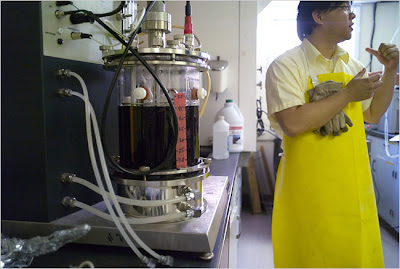
Some researchers, like Mr. Holser, are simply trying to find new uses for the regular byproducts of biofuels: distillers’ dry grain from corn ethanol and lignin from cellulosic ethanol.

Other researchers are trying to develop technologies and processes that could yield different, more valuable byproducts. And still others are placing their bets on “biorefineries.”

In the foothills of the Rocky Mountains, not far from the Coors brewery in Golden, Colo., PureVision Technology is making lignin. A natural compound that helps provide strength and rigidity in plants, lignin makes up 15 to 25 percent of most plants.

Most plans for cellulosic ethanol processing call for burning the lignin to generate steam and heat to run the process. As a fuel, lignin is worth around $40 a ton.

PureVision has devised a way to make a different form of lignin — one with a molecular composition that could make it an attractive material for a variety of industrial products like glues, sealants and detergents.

Ed Lehrburger, PureVision’s founder and chief executive, said he thought his lignin could sell for $300 a ton or more. Mr. Lehrburger said his company was collaborating with a wood and paper products manufacturer that is interested in using the lignin for a biobased glue for its laminates, plywoods and other products.

“Lignin is going to be one of the big drivers of the switch from oil-based to biobased products,” Mr. Lehrburger predicted.

In Ames, Iowa, Victor Lin has created a technology that changes the production process for biodiesel. Among other attributes, Mr. Lin’s invention yields a higher quality form of glycerol, which could be more easily converted into useful industrial materials. A chemistry professor and the associate director of the Center for Catalysis at Iowa State University, Mr. Lin is also the founder of a company, Catilin, which is backed by an initial $3 million in venture financing from MDV.

The production of biodiesel fuel requires a catalyst. Mr. Lin created a catalyst that is safer and easier to use than the one commonly used now, reducing the cost of producing biodiesel and its impact on the environment (requiring less water, for instance).

Dr. Lin and his colleagues are trying to turn the resulting glycerol into a substance called 1,3 propanediol, or PDO, the base material for a substance used in upholstery, carpets, clothing and other applications. DuPont uses PDO to make its Sorona line of fabrics.

“For every gallon of biodiesel you make, you make a pound of glycerol,” said George Kraus, a professor of chemistry at Iowa State, where he is director of the Center for Catalysis and a collaborator of Mr. Lin. “A lot of people have been contacting us about burning it, and we say there have to be better uses.”

The price of glycerol, now 20 to 50 cents a pound, could drop as low as 5 cents a pound as biodiesel production increases.

Mr. Kraus said the higher quality glycerol made with the new process could command a much higher price. “What we see,” he said, “is an opportunity to make something that might cost 80 cents a pound.”

In another lab at Iowa State, Robert C. Brown is using distillers’ dry grain —a main byproduct of corn ethanol that is largely sold as animal feed — to produce hydrogen and a compound called PHA. Mr. Brown hopes his version of PHA, which is biodegradable, could be used for surgical gowns and gloves that must now be disposed of as medical waste.

“Critics of corn ethanol like to say the process isn’t very efficient,” Mr. Brown said. “Part of that is because your products aren’t just fuel.” Finding other high-value applications, he added, lets producers “justly say, this is not a waste stream; it adds to the profitability of the plant.“

Back in Peoria, Mr. Vaughn is also looking at making products from distillers’ dry grain, including another biofuel. The grain is more than 10 percent oil, and one ton of it can yield 30 gallons of biodiesel.

Interest in the biorefinery model is not limited to research scientists and start-up companies. Archer Daniels Midland is expanding some of its wet mill plants, which already churn out ethanol and a variety of other corn-based materials like high-fructose corn syrup, amino acids and sorbitol, to make industrial products. It has begun making propylene glycol, a widely used compound, from glycerol.

“As petroleum prices increase and we try to become more independent with regard to energy and petroleum in general,” said Mark Matlock, senior vice president for research at the company, which is based in Decatur, Ill., “there are other opportunities that come up for industrial chemicals as well as fuels.”

But despite the many uses for byproducts, the biorefinery model is more difficult than it may seem. “The dream is the multiproduct biorefinery,” said Jim McMillan, manager of biorefining process research and development at the National Renewable Energy Laboratory in Golden, Colo. “The challenge is that the market for the fuels is like two orders of magnitude bigger than for even a fairly big chemical” that could be produced alongside the fuel.

biofuel
Via: The New York Times
by HILLARY ROSNER

sábado, junio 23, 2007

UNITED KINGDOM: Fruit could make 'powerful fuel'

The fuel, made from fructose, contains far more energy than ethanol, the scientists write in the journal Nature.

Separately, a British report on biofuels says all types of waste products, including plastic bags, can be used to make biodiesel fuel.

Critics of biofuels made from food crops say they drive up prices.

In both the European Union and the United States, politicians have heartily embraced biofuels as a way of reducing emissions of carbon dioxide and dependency on imported oil.

'Waste' fuel
Critics say that the current biofuels - both diesel made from palm oil and ethanol made from corn - encourage farmers to switch land to fuel production, driving up the price of food in the process.

Now scientists at the University of Wisconsin-Madison say that a simple sugar called fructose can be converted into a fuel that has many advantages over ethanol. It is called dimethylfuran - it can store 40% more energy than ethanol, and does not evaporate as easily.

The scientists say that fructose can be obtained directly from fruits and plants or made from glucose - but more work needs to be done to assess the environmental impact of this new fuel.

In Britain, researchers say that the technology now exists to create diesel fuel not just from palm oil but from a range of materials including wood, weeds and even plastic bags.

This process is called biomass to liquid and experts say that within six years up to 30% of Britain's diesel requirements could be met from this source.

Jeremy Tomkinson of the UK's National Non-Food Crops Centre said this next generation of biofuels could meet many needs beyond powering cars.

"The impact on society we're hoping will be far wider than simply 'we can give you a fuel now with a tenfold reduction in its carbon footprint'.

"Imagine now if chemicals that we use in the chemical industry also came from the same feed stock; [and that] the aircraft we fly to New York in also run on this? There's the big potential," he said.

The biggest drawback to this process is cost. Setting up new production facilities is estimated to be 10 times higher than for current biofuel refineries.
by Matt McGrath

Blogalaxia Tags:


sábado, abril 07, 2007

USA : La Polytechnic University de Nueva York crea un bioplástico de aceite vegetal que puede reciclarse como biodiesel

Un grupo de investigadores de la Polytechnic University de Nueva York ha desarrollado un novedoso tipo de bioplástico que se obtiene a partir de aceites vegetales que se puede transformar en biodiésel. El proceso permite obtener bioplástico para aplicaciones industriales que, tras depositarse en contenedores una vez usado, se transforma en biodiésel.

Además, el bioplástico es beneficioso para uso convencional porque tiene mejores propiedades de resistencia y duración que los polietilenos convencionales.

La investigación forma parte de un proyecto financiado en parte por diversas Administraciones públicas y que cuenta con aportaciones del Departamento de Defensa americano --1,7 millones de euros-- y de la empresa tecnológica 'DNA 2.0' que es la autora del proceso por el que se obtienen enzimas para descomponer el plástico.

El interés del ejército en este sistema viene dado por la necesidad de reciclar, de esta manera, el plástico obtenido y transformarlo, además, en carburante para sus vehículos de transporte.

Este grupo de científicos ha tratado de desarrollar una nueva fuente de energía sostenible, un tipo de plástico que pueda servir después de su vida útil como combustible limpio. Con la aportación económica del Departamento de Defensa norteamericano (DARPA) la idea es avanzar en el desarrollo de esta tecnología innovadora para transferirla al sector industrial. Su comercialización conducirá además a la consecución de una nueva fuente de energía 'verde' para los hogares de todo el mundo.

Según el Profesor Richard Gross, director del Centro Politécnico de la National Science Foundation University (NSF) y miembro de la empresa 'DNA 2.0', 'hemos demostrado que podíamos hacer un nuevo tipo de plástico a partir de aceites de plantas que tiene características notables, como la mayor resistencia y durabilidad que los plásticos típicos'. Además, después de su uso, este bioplástico se puede colocar en un envase simple donde se transforme con seguridad en combustible líquido.

Además, la posibilidad de obtener después biodiesel interesa al Departamento de Defensa porque utiliza un gran cantidad de plástico para envoltorios de materiales en los campos de entrenamiento, que podrá reciclar después para llenar los depósitos de su flota de vehículos, 'una ventaja doble, ya que reducirá la cantidad de residuos que genere y la cantidad de combustible que debe entregar a sus unidades móviles', explica por su parte el responsable del Programa en el Departamento de Defensa, Khine Latt.

La próxima fase de la investigación exigirá el desarrollo de un proceso más barato y eficiente de fabricación del bioplástico y su posterior transformación en biodiesel. Esta forma de generación de biodiesel es un paso 'muy importante' en el desarrollo de tecnologías 'verdes' y reducción de residuos tóxicos.


viernes, marzo 30, 2007

PERU: ¿Gas natural o biodiesel? mito y realidad

 by Luis Bravo
La Municipalidad Metropolitana de Lima, MML, a través de Protransportes, está próxima a licitar las rutas para los nuevos autobuses que reemplazarán el caótico sistema actual de camionetas rurales (combis asesinas), microbuses (no menos peligrosos) y autobuses viejos en su gran mayoría (menos peligrosos en frecuencia, pero de potencial mayor severidad en el riesgo), en un proceso gradual que esperamos no exceda de unos 3 a 5 años.

Una condición que impondría la MML, es que estas nuevas unidades sean a “gas natural vehicular–GNV” -combustible fósil- de modo de asegurarle una aplicación al gas de Camisea. Habría mediado una especie de acuerdo entre el alcalde y el presidente García. Como este sería un acuerdo de tipo político, comenzaremos por un análisis técnico y económico y luego comentaremos las implicancias políticas de esta aparente “decisión tomada”, con el mejor ánimo de aportar criterios y no de perturbar acuerdos.

¿Es beneficioso para la ciudad, los usuarios del transporte y el medio ambiente que los nuevos autobuses de Lima sean a GNV?. A simple vista es sí; no puede ser otra la respuesta frente a la caótica situación del tránsito en la ciudad y a la calidad del aire que respiramos. Pero, ¿es esa la mejor solución técnicamente, socialmente, ambientalmente, económicamente y políticamente?; vayamos al comentario analítico y al final contestemos esta pregunta.

Comencemos por una mención glosada a la mejor exposición técnica en favor del GNV:

De la nota “Buses a gas natural: separando el mito de la realidad” publicada por el laboratorio nacional de energía renovable (NREL), patrocinado por la oficina de eficiencia energética y energía renovable de tecnologías de transporte de los EE.UU. (Octubre 2001).

Esta nota hace una elaboración que soporta la introducción de autobuses a gas natural para el transporte de pasajeros, haciendo una comparación con las características técnicas y la operación de autobuses a diesel de petróleo. En la nota se hacen las siguientes afirmaciones:

En ese momento los autobuses a GNV representaban cuanto menos el 20% de los autobuses nuevos en el mercado.

... los autobuses a GNV consistentemente emiten considerablemente menos partículas que los autobuses a diesel ... una muestra tomada en Boulder, Colorado, arrojó una reducción de 97% en partículas y del 58% en óxidos de nitrógeno ...
... el gas natural de por sí tiene menores emisiones de CO2 que el diesel. Considerando el ciclo total de combustible de ambos, diesel y GNV, incluyendo las emisiones durante la producción del combustible, los autobuses a GNV parecen tener el total de emisiones de gas invernadero muy semejante, sino ligeramente mejor, que las de los autobuses de diesel, a pesar de emitir niveles más altos de metano.
... los autobuses de GNV cuestan aproximadamente de 25 a 50 mil dólares más que un autobús convencional de diesel (ello depende del modelo y cualquier equipo especial que pueda ordenarse); pero el combustible GNV por lo general, cuesta menos que el combustible diesel. ...
... las emisiones de los motores diesel de autobuses nuevos han mejorado mucho en los últimos 10 años ... (ojo: sigue comparando lo relativo a emisiones, seguridad y mantenimiento, con ventaja para los autobuses a GNV versus el diesel de petróleo) ...
... los tanques para GNV son más costosos que los tanques a combustible diesel ... (aunque este sea un tema tecnológico que debe superarse si no esta superado ya)
... los motores a GNV tienen encendido por chispa y por tanto, requieren mantenimiento periódico del sistema de encendido (bujías, cables, etc ...). Los motores a diesel no usan bujías, así que no necesitan este tipo de mantenimiento ....
... los autobuses a GNV sí pesan más que los autobuses convencionales a diesel ...

Es claro –reiteramos- que esta comparación se hace versus los buses a diesel de petróleo, que si bien son los mismos que los futuros buses a biodiesel (lo que resulta una ventaja técnica porque es una tecnología ampliamente conocida y dominada), las condiciones medioambientales son dramáticamente distintas cuando operan con el biocombustible; veamos:

Recurrimos al estudio del experto argentino ingeniero Jorge Ugolini que determina la factibilidad técnica y económica del desarrollo del biodiesel y que hace una comparación entre las emisiones del biodiesel puro al 100% (B100), versus el gasoil, que es una mezcla del diesel de petróleo con 20% de biodiesel (B20); combinamos sus conclusiones con las del estudio de la experta española Brenda Bär (Barcelona), que observa las emisiones de CO, HC, NOx, partículas, SO2 y CO2, y que termina indicando que el biodiesel es un combustible que no contiene azufre y que tiene unos niveles de emisión significativamente inferiores a los del gasóleo; y finalmente integrando las conclusiones del estudio del ministerio de industria, turismo y comercio de España que compara el gasóleo y el gas natural (GNV); se deduce que el gasóleo produce 73kg de CO2 por Gj (medida de energía), el GNV 57kg y el biodiesel 14kg. Es decir, el biodiesel emite 76% menos CO2 que el GNV. Generalmente se sostiene que emite la mitad (50%), aunque el análisis arroja que emite menos de la mitad.

Sobre el precio de gas natural en Perú, recordemos que cuando en el 2000 el gobierno le adjudicó el lote 88 a Pluspetrol, inexplicable y extrañamente permitió indexar el precio del gas a una fórmula con base al precio internacional del barril de petróleo que estaba entonces, en US$ 24 (el presidente García en el discurso al inaugurar su segundo gobierno el 28 de julio último, dijo que revisaría este contrato de inmediato ... al día siguiente). ¿Qué tiene que ver que el petróleo suba en los países productores, con los costos de producción de Pluspetrol en Camisea?. Aunque se sostenga que todavía sigue siendo rentable usar gas natural, ahora tenemos el gas más caro de la región. Argentina, que importa gas de Bolivia, lo hace a US$ 0.07 centavos por metro cúbico, mientras que los industriales peruanos compran a más del doble. En la situación actual del contrato de Camisea, Pluspetrol variará anualmente el precio del gas natural en función del precio del barril de petróleo; a menos que esto lo renegocie el actual gobierno como lo ofreció el presidente García.

En resumen: el autobús a GNV, costará bastante más que el bus a biodiesel; a pesar de la nota glosada del NREL (año 2001), el autobús a GNV no está suficientemente difundido en el mundo y la producción, venta e ingreso al servicio público de autobuses a biodiesel es inmensamente superior en los últimos 5 años (en Europa prefieren largamente el bus a biodiesel); la capacidad técnica instalada en el Perú, es muy superior para el servicio de mantenimiento en la tecnología a biodiesel que a GNV, que es diminuta; el GNV tiene 130 octanos y por tanto se exige más el motor, el que -según algunos expertos- requerirá ser cambiado en proporción de por lo menos 2 veces por 1 en el mismo periodo con respecto al bus a biodiesel. El GNV emite más del doble de CO2 que el biodiesel. El gas natural lo hace disponible Camisea a un precio que por contrato, está sujeto anualmente a las variaciones del precio del barril de petróleo; el biodiesel es un desarrollo prioritario a nivel nacional y en corto plazo estará disponible en el mercado a precios más competitivos y estables (no sujetos al precio del barril de petróleo).

Voltairenet

Label Cloud

The Energy Blog