Mostrando entradas con la etiqueta biofuel. Mostrar todas las entradas

miércoles, mayo 07, 2008

BRASIL: The brazilian government rejects biofuels criticism

BRASIL: The brazilian goverment rejects biofuels criticismThe Brazilian president has rejected criticism that his country's production of biofuels has forced a surge in global food prices and harms the environment. Luiz Inacio Lula da Silva accused critics of being driven by economic and political interests, and failing to highlight soaring oil prices and increased demand as a factor in pushing up food production costs.

"Don't tell me, for the love of God, that food is expensive because of biodiesel," he told reporters.

"Food is expensive because the world wasn't prepared to see millions of Chinese, Indians, Africans, Brazilians and Latin Americans eat. We want to discuss this not with passion but rationality and not from the European point of view."

Lula made his comments following a week of protests in Brazil and Europe against the fuels made from food crops and their supposed environmental and social consequences.

This week, the EU's environmental chief, Stavros Dimas, said that biofuels, which Brazil hopes to export to the EU, must now meet social and environmental conditions, and that "the issue of sustainabilty criteria is of crucial importance."

Scientists from the European Environment Agency urged the 27-nation bloc to drop its 10% biofuel target for road transport fuels.

Lula rebuffed accusations by Jean Ziegler, the UN's special rapporteur for the right to food, that biofuels were a "crime against humanity".

"The real crime against humanity is to discredit biofuels a priori and condemn food-starved and energy-starved countries to dependence and insecurity," Lula said.

Some of Brazil's neighbours, led by oil-rich Venezuela, warned this week that biofuels could increase malnutrition in Latin America. Lula said he was "shocked" that biofuel critics failed to mention the impact that high oil prices had on food production costs.

"It's always easier to hide economic and political interests behind supposed social and environmental interests," he said.

The growing criticism has placed Brasil at the centre of the global biofuels debate. The country has enjoyed an agricultural export boom, and has become the world's largest exporter of ethanol, which is derived from sugar cane. Critics say the increased production of crops for ethanol and biodiesel, which is derived from oil seeds, competes for land with food crops, and is pushing cattle ranchers and farmers further north in Brasil, contributing to the destruction of the Amazon rainforest.

But the Brazilian government has argued that it has plenty of unused land to plant crops for biofuels and that current production was still too small to affect food prices.

Source: The Guardian| by Anil Dawar


Found this post useful? Consider subscribing to
.

miércoles, marzo 12, 2008

UNITED STATES: The Future Of Biofuels

UNITED STATES: The Future Of BiofuelsHigh oil prices, energy security considerations and fears about global warming have helped revive interest in renewable energy sources like biofuels, which burn cleanly and can be produced from plants.

But there are a few catches, particularly regarding biofuels like corn-based ethanol: the more corn is used in ethanol production, the less is available for food-a reality that partly accounts for the recent run-up in world food prices. Moreover, most of the 6 billion gallons of ethanol produced annually in the United States comes from corn, but there's not enough corn available to make it a viable long-term source.

MIT Professor Gregory Stephanopoulos lead a discussion of the various ways scientists and energy policymakers are seeking to overcome these limitations and make biofuels from renewable biomass feedstocks a significant part of the U.S. energy supply during a symposium.

The symposium, "Biomass to Biofuels Conversion: Technical and Policy Perspectives," explored two aspects of biofuels: The first half covered biofuels policy and the second focussed on technical issues in converting biomass to fuel.

Stephanopoulos, the Willard Henry Dow Professor of Chemical Engineering, discussed his own research, which involves bioengineering yeast. He and colleagues have developed a new way to engineer the genome of yeast to produce desirable traits-specifically, the ability to tolerate high levels of ethanol, which is normally toxic to yeast. The technique holds promise for the development of other traits that would make yeast more-efficient ethanol producers.

He also touched on other lines of biofuel research, including using plant materials to produce ethanol. To replace corn, scientists are turning to cellulose found in grasses and agricultural wastes.

"The technology to produce cellulosic ethanol is not there yet," Stephanopoulos said. However, he estimates that large-scale, economically feasible production of ethanol from cellulose could happen within 10 years.


Source: SPX| by Anne Trafton

Found this post useful? Consider subscribing to
.

sábado, febrero 09, 2008

WESTERN HEMISPHERE: Converting land for biofuel worsens global warming

Clearing raw land to produce biofuels actually contributes to global warming by emitting large amounts of greenhouse gases into the atmosphere, researchers warned Thursday.

Carbon dioxide (CO2) emissions from new croplands carved into rainforests, savannas, wetlands or grasslands would easily surpass the overall amount of CO2 emissions reduced through the use of biofuels, according to a report in the February 8 edition of Science.

"If you're trying to mitigate global warming, it simply does not make sense to convert land for biofuels production," said Joe Fargione, a founder of private environment protection agency the Nature Conservancy and co-author of the study.

"All the biofuels we use now cause habitat destruction, either directly or indirectly," he said.

"Global agriculture is already producing food for six billion people. Producing food-based biofuel, too, will require that still more land be converted to agriculture."

Converting land to grow corn, sugar cane or soy beans -- crops used in the production of biofuels -- creates a "biofuel carbon debt" by releasing 17 to 420 times as much CO2 into the atmosphere as the greenhouse gas reductions which the biofuels provide by displacing fossil fuels.

Carbon is stored in dead trees and plants as well as in the soil, and naturally seeps into the atmosphere in the form of CO2. Converting native habitats to cropland increases the release of CO2 into the air, the report said.

It would take years, and in some cases centuries, before biofuels derived from crops on converted land would lead to a net reduction of greenhouse gases, according to the report.

The researchers calculated that in Indonesia, where wetlands are being converted to grow palm oil to produce biofuels, it will take 423 years before biofuel CO2 emmission savings would repay the carbon debt caused by the land conversion.

"We don't have proper incentives in place because landowners are rewarded for producing palm oil and other products but not rewarded for carbon management," said report co-author Stephen Polasky, an applied economics professor at University of Minnesota.

"This creates incentives for excessive land clearing and can result in large increases in carbon emissions."

An incentive for carbon sequestration or a penalty for carbon emmissions is needed in order to slow CO2 emissions and environmental destruction, Polasky said.

The researchers noted that strong growth in the demand for corn-based ethanol in the United States has led to the increasing destruction of the Amazon rainforest in Brazil.

To address the ethanol demand, US farmers have stopped rotating corn crops with soy, leaving their Brazilian counterparts to produce more soybeans to meet rising global demand, resulting in further Amazon deforestation, they said.

The report stresses that certain biofuels do not contribute to global warming because they leave the natural ecosystem intact, and that obtaining biofuels from biomass waste or forestry products such as wood chips causes less harm to the environment and is the aim of several scientists.


Source: Agence France Presse

Found this post useful? Consider subscribing to
.

jueves, septiembre 13, 2007

BIOFUELS: Brasil y Suecia acuerdan promover el uso de la bioenergía y los biocombustibles

Suecia y Brasil firmaron en Estocolmo un Memorando de Entendimiento para promover el uso de la bioenergía e impulsar la creación de un mercado mundial de biocombustibles.

El documento fue firmado por la ministra de Industria sueca, Maud Olofsson, y el ministro de Asuntos Exteriores brasileño, Celso Amorim, dentro de la agenda de la visita del presidente de Brasil, Luiz Inácio Lula da Silva, a este país escandinavo.

Brasil y Suecia se comprometen por el acuerdo a incrementar la colaboración entre investigadores y empresas de ambos países con vistas a desarrollar técnicas mejores y más efectivas para lograr una producción sostenible, señaló el Gobierno sueco en un comunicado.

El memorando establece también que las dos partes estudiarán la posibilidad de ayudar a países en vías de desarrollo a promover el uso de energías renovables, incluidos los biocombustibles, así como su producción y utilización.

"Brasil es el primer productor mundial de etanol y tiene una larga experiencia en la producción y el uso de combustibles alternativos. Para Suecia es fundamental firmar un acuerdo bilateral, porque necesita de cooperación internacional para desarrollar la próxima generación de combustibles", señaló Olofsson en el comunicado.

Via|EFE


Found this post useful? Consider subscribing to
.

martes, agosto 14, 2007

CANADA: McGuinty Government Invests In Green Industry

The McGuinty Government is helping Sarnia-Lambton's petrochemical industry develop environmentally friendly alternatives to fossil fuels by supporting a new Bioindustrial Innovation Centre, Minister of Culture Caroline Di Cocco announced today on behalf of the Premier and Minister of Research and Innovation Dalton McGuinty.

"We are on the side of Ontarians who want a prosperous economy and a clean environment," said Premier McGuinty. "This project is helping Ontario become a leader in environmental protection and driving the new knowledge-based economy that is based on creative, forward-thinking ideas, leading-edge research and new technologies."

The new Bioindustrial Innovation Centre will connect researchers and the local petrochemical industry to create and commercialize new sources of clean fuel. The centre, acting in partnership with others in the community, is expected to attract over $1 billion in private sector investment by 2014, immediately support up to 1,000 jobs in research and engineering, and help attract new bioindustrial plants to the petrochemical industry in Sarnia.

"A good part of Ontario's industrial base was built on energy and chemicals created from fossil fuels right here in Sarnia-Lambton," said Minister Di Cocco. "This new innovation centre will leverage that expertise and infrastructure, and make Ontario a leader in developing renewable alternatives. The result will be a competitive new industry that is also environmentally sustainable."

Located at the University of Western Ontario's Sarnia-Lambton Research Park, the centre will help support the development of a bio-hybrid chemical industry. The McGuinty government is committing $10 million to the project, which is also receiving support from the University of Western Ontario's Sarnia-Lambton Research Park, the City of Sarnia and Lambton County.

A retrofit of 60,000 sq. ft. of existing laboratory space will provide a commercialization centre with incubator suites, laboratory equipment, pilot plant space, and growth space for start-up companies. An additional 60,000 sq. ft. of new office space will serve as an accelerator centre to house Colt Engineering, a current tenant of the research park. Colt Engineering is a rapidly growing company specializing in project management of ethanol,
biodiesel, and bio-chemical plants, as well as traditional petrochemical facilities.
"The centre will support both research and commercialization," said

Minister Di Cocco. "There is widespread industry and community support for a hybrid industry that integrates the traditional petrochemical industry with the new bioeconomy.

The Bioindustrial Innovation Centre is a strategic use of existing industry and infrastructure to achieve industrial scale biotechnology. It is a big step forward in building the Ontario of the future with clean, green jobs."

Investing in research and innovation is another example of how the McGuinty government is working on the side of businesses and families to strengthen Ontario's economy.

Via: CNW


Found this post useful? Consider subscribing to .


miércoles, agosto 08, 2007

TECHNOLOGY: Cooking Up More Uses for the Leftovers of Biofuel Production

The baking tins and muffin cups lining the countertops in a corner of Ronald Holser’s cluttered laboratory were filled with curious substances resembling angel food cakes and loaves of bread. But Mr. Holser did not advise eating them. The concoctions were prototypes for biodegradable weed barriers and sticky films intended to hold grass seeds on the ground long enough to germinate.

If Mr. Holser, a research chemist, and his colleague Steven F. Vaughn, a plant physiologist, are successful, they will have found more than ecologically friendly ways to fight weeds and grow grass.

They will have found innovative uses for a byproduct of the production of biodiesel fuel, glycerol. This, in turn, could help transform the biodiesel industry into something that more closely resembles the petroleum industry, where fuel is just one of many profitable products.

“Just like petroleum refineries make more than one product that are the feedstock for other industries, the same will have to be true for biofuels,” said Kenneth F. Reardon, a professor of chemical and biological engineering at Colorado State University in Fort Collins. “Biorefining is what the vision has to look like in the end.”

Glycerol is used in a variety of products, including foods, soap and dynamite. But as biodiesel fuel production in the United States has risen, the market for glycerol has become saturated.

If scientists like Mr. Holser, who works at the United States Department of Agriculture’s research center in Athens, Ga., and Mr. Vaughn, who works at the department’s National Center for Agricultural Utilization Research in Peoria, Ill., can expand the number of valuable uses for the syrupy liquid, biodiesel makers could sell their glycerol instead of paying someone to haul it away.

“Every week I get at least one or two calls from biodiesel producers who have all this glycerol and don’t know what to do with it,” Mr. Holser said.

Glycerol, also called glycerin, is not the only byproduct of biofuel production that is the subject of experiments. Scientists are also looking at profiting from the leftovers from the production of corn ethanol and cellulosic ethanol, made from materials like switch grass, corn husks and prairie grass. Around the country, scientists, entrepreneurs and venture capitalists are becoming increasingly interested in making more than fuel out of the raw materials for biodiesel fuel and ethanol.

TECHNOLOGY: Cooking Up More Uses for the Leftovers of Biofuel Production“The opportunity, as we think about increasing our consumption of biologically derived fuels, is to consider what besides fuels can we make,” said Erik Straser, general partner of MDV Mohr Davidow Ventures, a venture capital firm in Menlo Park, Calif.

Some researchers, like Mr. Holser, are simply trying to find new uses for the regular byproducts of biofuels: distillers’ dry grain from corn ethanol and lignin from cellulosic ethanol.

Other researchers are trying to develop technologies and processes that could yield different, more valuable byproducts. And still others are placing their bets on “biorefineries.”

In the foothills of the Rocky Mountains, not far from the Coors brewery in Golden, Colo., PureVision Technology is making lignin. A natural compound that helps provide strength and rigidity in plants, lignin makes up 15 to 25 percent of most plants.

Most plans for cellulosic ethanol processing call for burning the lignin to generate steam and heat to run the process. As a fuel, lignin is worth around $40 a ton.

PureVision has devised a way to make a different form of lignin — one with a molecular composition that could make it an attractive material for a variety of industrial products like glues, sealants and detergents.

Ed Lehrburger, PureVision’s founder and chief executive, said he thought his lignin could sell for $300 a ton or more. Mr. Lehrburger said his company was collaborating with a wood and paper products manufacturer that is interested in using the lignin for a biobased glue for its laminates, plywoods and other products.

“Lignin is going to be one of the big drivers of the switch from oil-based to biobased products,” Mr. Lehrburger predicted.

In Ames, Iowa, Victor Lin has created a technology that changes the production process for biodiesel. Among other attributes, Mr. Lin’s invention yields a higher quality form of glycerol, which could be more easily converted into useful industrial materials. A chemistry professor and the associate director of the Center for Catalysis at Iowa State University, Mr. Lin is also the founder of a company, Catilin, which is backed by an initial $3 million in venture financing from MDV.

The production of biodiesel fuel requires a catalyst. Mr. Lin created a catalyst that is safer and easier to use than the one commonly used now, reducing the cost of producing biodiesel and its impact on the environment (requiring less water, for instance).

Dr. Lin and his colleagues are trying to turn the resulting glycerol into a substance called 1,3 propanediol, or PDO, the base material for a substance used in upholstery, carpets, clothing and other applications. DuPont uses PDO to make its Sorona line of fabrics.

“For every gallon of biodiesel you make, you make a pound of glycerol,” said George Kraus, a professor of chemistry at Iowa State, where he is director of the Center for Catalysis and a collaborator of Mr. Lin. “A lot of people have been contacting us about burning it, and we say there have to be better uses.”

The price of glycerol, now 20 to 50 cents a pound, could drop as low as 5 cents a pound as biodiesel production increases.

Mr. Kraus said the higher quality glycerol made with the new process could command a much higher price. “What we see,” he said, “is an opportunity to make something that might cost 80 cents a pound.”

In another lab at Iowa State, Robert C. Brown is using distillers’ dry grain —a main byproduct of corn ethanol that is largely sold as animal feed — to produce hydrogen and a compound called PHA. Mr. Brown hopes his version of PHA, which is biodegradable, could be used for surgical gowns and gloves that must now be disposed of as medical waste.

“Critics of corn ethanol like to say the process isn’t very efficient,” Mr. Brown said. “Part of that is because your products aren’t just fuel.” Finding other high-value applications, he added, lets producers “justly say, this is not a waste stream; it adds to the profitability of the plant.“

Back in Peoria, Mr. Vaughn is also looking at making products from distillers’ dry grain, including another biofuel. The grain is more than 10 percent oil, and one ton of it can yield 30 gallons of biodiesel.

Interest in the biorefinery model is not limited to research scientists and start-up companies. Archer Daniels Midland is expanding some of its wet mill plants, which already churn out ethanol and a variety of other corn-based materials like high-fructose corn syrup, amino acids and sorbitol, to make industrial products. It has begun making propylene glycol, a widely used compound, from glycerol.

“As petroleum prices increase and we try to become more independent with regard to energy and petroleum in general,” said Mark Matlock, senior vice president for research at the company, which is based in Decatur, Ill., “there are other opportunities that come up for industrial chemicals as well as fuels.”

But despite the many uses for byproducts, the biorefinery model is more difficult than it may seem. “The dream is the multiproduct biorefinery,” said Jim McMillan, manager of biorefining process research and development at the National Renewable Energy Laboratory in Golden, Colo. “The challenge is that the market for the fuels is like two orders of magnitude bigger than for even a fairly big chemical” that could be produced alongside the fuel.
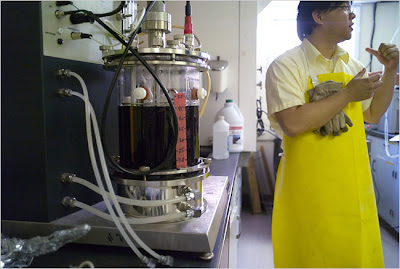
biofuel
Via: The New York Times
by HILLARY ROSNER

sábado, julio 07, 2007

BRASIL: Brazilian biofuel beckons Europe [video]


Brussels sees Brazil as a key player in the fight against global warming. With the tenth largest economy in the world, Brazil is home to most of the Amazon rainforest. It is a major producer of biofuels. President Lula da Silva is due at a conference in Brussels this Thursday where the main goal will be to foster consumption and production of fuel made from crops. EU leaders agreed in March to boost the role of biofuels, with a clear deadline.

Christian Bergsmuller is a member of the EU delegation in Brazil: "If the EU (has) that ambitious agenda of moving to about 20% of renewable energy by 2020 - which is very ambitious - we know that we have to import from other parts of the world, and Brazil will certainly have a stake in our energy mix in the future."

In the future, if trade and investment end up predominantly bilateral, this risks complicating business dealings further afield. Brazil is the EU's main trading partner in Latin America but broader interests cannot be ignored.

Analyst Mario Telo in Brussels says Europe is learning from previous experience with other major South American players: "The probable result will be to reinforce Europe-Latin America ties following on from the continent's number one country. The risk is that an individual partnership with Brazil might create difficulties in relations with other Latin American partners. The one-on-one approach proposes a bilateral model such as exists with Chile and Mexico. The Portuguese EU presidency wants to avoid this danger."

With 188 million people, Brazil is a land of huge contrasts - the better-off playing while the slum-dwellers stagnate. Newly-stable Brazil is looking towards Europe to reinforce its international prospects to help bring benefits to the poorest places.


Blogalaxia Tags:


sábado, junio 23, 2007

UNITED KINGDOM: Fruit could make 'powerful fuel'

The fuel, made from fructose, contains far more energy than ethanol, the scientists write in the journal Nature.

Separately, a British report on biofuels says all types of waste products, including plastic bags, can be used to make biodiesel fuel.

Critics of biofuels made from food crops say they drive up prices.

In both the European Union and the United States, politicians have heartily embraced biofuels as a way of reducing emissions of carbon dioxide and dependency on imported oil.

'Waste' fuel
Critics say that the current biofuels - both diesel made from palm oil and ethanol made from corn - encourage farmers to switch land to fuel production, driving up the price of food in the process.

Now scientists at the University of Wisconsin-Madison say that a simple sugar called fructose can be converted into a fuel that has many advantages over ethanol. It is called dimethylfuran - it can store 40% more energy than ethanol, and does not evaporate as easily.

The scientists say that fructose can be obtained directly from fruits and plants or made from glucose - but more work needs to be done to assess the environmental impact of this new fuel.

In Britain, researchers say that the technology now exists to create diesel fuel not just from palm oil but from a range of materials including wood, weeds and even plastic bags.

This process is called biomass to liquid and experts say that within six years up to 30% of Britain's diesel requirements could be met from this source.

Jeremy Tomkinson of the UK's National Non-Food Crops Centre said this next generation of biofuels could meet many needs beyond powering cars.

"The impact on society we're hoping will be far wider than simply 'we can give you a fuel now with a tenfold reduction in its carbon footprint'.

"Imagine now if chemicals that we use in the chemical industry also came from the same feed stock; [and that] the aircraft we fly to New York in also run on this? There's the big potential," he said.

The biggest drawback to this process is cost. Setting up new production facilities is estimated to be 10 times higher than for current biofuel refineries.
by Matt McGrath

Blogalaxia Tags:


miércoles, mayo 23, 2007

CUBA: it is to modernize its ethanol production despite Castro opposition to biofuel

by Andrea Rodriguez
Read more | Digg story

Cuba is quietly modernizing its ethanol-producing facilities, despite Fidel Castro's repeated assertions that making more of the biofuel could starve the world's poor.

The island plans to upgrade 11 of its 17 refineries, which produce up to 47 million gallons annually of ethanol from sugar cane, said Conrado Moreno, a member of Cuba's Academy of Sciences. The refineries currently produce alcohol for use in rum and other spirits, as well as medications and cooking on the island. But the improvements will give Havana the capacity to one day produce fuel for cars, Moreno told reporters at a conference on renewable energy. Ethanol produced in Cuba is not for cars now, but "in four or five years, we'll see," he said.

Castro has railed against a U.S.-backed plan to produce ethanol from corn for cars in a series of editorials published in state-run newspapers, claiming it will cause prices of farm products of all kinds to spike and make food too expensive for poor families around the globe.

Castro has not been seen in public since undergoing emergency intestinal surgery and stepping aside in favour of a government run by his 75-year-old brother Raul, the defence minister. Officials insist his health is improving.

In contrast to Fidel Castro, who has depicted corn-produced ethanol for cars as a potential global catastrophe, Moreno conceded the variety produced from sugar cane could bring economic opportunity to some "isolated communities" in Cuba.

Brazil is the world's leading producer of ethanol from sugar cane. In March, it signed an agreement with the United States to promote ethanol production in Latin America and create international quality standards to allow it to be traded as a commodity like oil.

That agreement helped spark the editorials from Castro, which have been read repeatedly on state television and radio. In them, Castro distinguishes between the cane ethanol Cuba produces and the corn-based biofuel common in the U.S.

The 80-year-old revolutionary released another signed opinion to foreign journalists Tuesday night, saying the damaging effects of producing ethanol from corn were not new.

"The dangers to the environment and the human species are topics on which I have been mediating for years," Castro wrote. "What I never imagined was the immense risk."


Blogalaxia Tags:


domingo, mayo 13, 2007

BIOFUEL: Sake may power Japanese cars of the future

Japanese motorists may one day pump their cars full of sake, the fermented rice wine that is Japan's national drink, if a pilot project to create sake fuel is a hit with locals in this mountain resort.

The government-funded project at Shinanomachi, 124 miles northwest of Tokyo, will produce cheap rice-origin ethanol brew with the help of local farmers who will donate farm waste such as rice hulls to be turned into ethanol.

"We want to present the next generation a preferable blueprint--a self-sustainable use of local fuels," said Yasuo Igarashi, a professor of applied microbiology at the University of Tokyo who heads the three-year project.

If the project catches on with locals, then it could pave the way for similar endeavors across Japan that will see Japanese cars running on Japanese-made biofuels in the future, he added.

Japan, the world's second largest gasoline consumer after the United States, is entirely dependent on crude oil imports and it has been hit by the surge in oil prices.

With hefty carbon emissions reduction targets to meet under the Kyoto protocols, Japan is turning to biofuels. Yet motorists in Japan are still far behind drivers in Europe and the United States in their consumption of green fuels.

Some analysts say Japan is at a major disadvantage as high prices for local farm produce mean locally-made green fuels are exorbitantly expensive.

Added to that is a lack of support from the country's powerful oil distributors and a failure by the government to provide policy incentives such as mandatory usage.

That is where Igarashi and his team come in. They hope to show that biofuels are feasible and inexpensive by developing a low-cost fuel and encouraging a local community of about 10,000 people to take part in producing that fuel.

Sweet aroma of biofuels
Production has just begun at the facility at a former high school field in Shinanomachi and a sweet, sour aroma, similar to that of unfiltered sake, wafts into the air.

"We like the idea," said Shigehiro Matsuki, the mayor of Shinanomachi.

"The new fuels are renewable...instead of fossil fuels which are running out."

Unlike spacious sugar cane plantations in the No.1 ethanol exporter, Brazil, family farming is dominant in Japan, with a majority of farmers working regular jobs and growing rice, the staple food, on their weekends.

There is plenty of potential to develop biofuels from agriculture waste and abandoned farmland, Igarashi said.

The project will test its biofuel on a "flex-fuel vehicle", which can run on any mixture of gasoline and green fuels and which is gaining popularity in the rest of the world as the battle against global warming heats up.

But Japan has no flex-fuel vehicles even though Japanese car companies Honda and Toyota produce them for the market in Brazil. So the team imported a red Ford Focus from Britain for the project.

With 2.2 pounds of rice needed to produce 0.5 liter of ethanol, the main challenge will be creating a low cost biofuel that can compete with ordinary gasoline, which is now sold at around $1.13 a liter, including gasoline related taxes of some 47 cents.


Blogalaxia Tags:


miércoles, abril 18, 2007

BIOFUEL: Brazil's ethanol revolution

Many hail it as the fuel of the future. But in Brazil, ethanol is part of the here and now. The country has pioneered use of this alternative way to power motor vehicles, so much so that today around 80 percent of new cars sold in Brazil can run on ethanol as well as petrol. Tax incentives have boosted the appeal of these so-called "flex-fuel" cars, making them an attractive option for the Brazilian motorist.
It is three decades since Brazil's energy revolution began. Keen to reduce its dependence on expensive Middle Eastern petrol in the wake of the 1970s oil crisis, the country started transforming sugar cane into the clear liquid called ethanol that motorists can pump into their cars. Supporters praise its green credentials.
Biofuels are seen as an ideal way to reduce emissions of greenhouse gases believed to contribute to climate change. But critics complain that planting crops to produce fuel wastes land and water resources that could otherwise be used to grow food. They also claim that the Amazon rainforest is under threat from increasingly lucrative sugar cane plantations. Brazil and the United States combined produce around 70 per cent of the World's ethanol, although in the US the biofuel is mainly made from corn.
Last month the two nations agreed to co-operate in promoting ethanol. Both hailed the environmental and economic importance of their agreement. The deal makes the biofuel a commodity on the international market, in what some see as an attempt by the United States and Brazil to counterbalance the all-powerful OPEC cartel of oil-producing nations.

jueves, febrero 15, 2007

MIT ethanol analysis confirms benefits of biofuels

Controversy over the benefits of using corn-based ethanol in vehicles has been fueled by studies showing that converting corn into ethanol may use more fossil energy than the energy contained in the ethanol produced. Now a new MIT analysis shows that the energy balance is actually so close that several factors can easily change whether ethanol ends up a net energy winner or loser.
Regardless of the energy balance, replacing gasoline with corn-based ethanol does significantly reduce oil consumption because the biomass production and conversion process requires little petroleum. And further MIT analyses show that making ethanol from cellulosic sources such as switchgrass has far greater potential to reduce fossil energy use and greenhouse gas emissions.
The Bush administration is pushing the use of ethanol as a domestically available, non-petroleum alternative to gasoline. But most U.S. ethanol is now made from corn, and growing corn and converting the kernels into ethanol consume a lot of energy--comparable to what is contained in the ethanol produced. Making ethanol from corn stalks, other agricultural wastes and wild grasses would consume less energy, but the technology for converting them to ethanol may not be economically viable for another five or so years.
Does using corn-based ethanol in place of gasoline actually make energy consumption and emissions go up, as some researchers claim? Why do others reach the opposite conclusion? And how much better would ethanol from "cellulosic" feedstocks such as switchgrass be?
To answer those questions, Tiffany A. Groode, a graduate student in MIT's Department of Mechanical Engineering, performed her own study, supervised by John B. Heywood, Sun Jae Professor of Mechanical Engineering.
Using a technique called life cycle analysis, she looked at energy consumption and greenhouse gas emissions associated with all the steps in making and using ethanol, from growing the crop to converting it into ethanol. She limited energy sources to fossil fuels. Finally, she accounted for the different energy contents of gasoline and ethanol. Pure ethanol carries 30 percent less energy per gallon, so more is needed to travel a given distance.
While most studies follow those guidelines, Groode added one more feature: She incorporated the uncertainty associated with the values of many of the inputs. Following a methodology developed by recent MIT graduate Jeremy Johnson (Ph.D. 2006), she used not just one value for each key variable (such as the amount of fertilizer required), but rather a range of values along with the probability that each of those values would occur. In a single analysis, her model runs thousands of times with varying input values, generating a range of results, some more probable than others.
Based on her "most likely" outcomes, she concluded that traveling a kilometer using ethanol does indeed consume more energy than traveling the same distance using gasoline. However, further analyses showed that several factors can easily change the outcome, rendering corn-based ethanol a "greener" fuel.
One such factor is the much-debated co-product credit. When corn is converted into ethanol, the material that remains is a high-protein animal feed. One assumption is that the availability of that feed will enable traditional feed manufacturers to produce less, saving energy; ethanol producers should therefore get to subtract those energy savings from their energy consumption. When Groode put co-product credits into her calculations, ethanol's life-cycle energy use became lower than gasoline's.
Another factor that influences the outcome is which energy-using factors of production are included and excluded--the so-called system boundary. A study performed by Professor David Pimentel of Cornell University in 2003 includes energy-consuming inputs that other studies do not, one example being the manufacture of farm machinery. His analysis concludes that using corn-based ethanol yields a significant net energy loss. Other studies conclude the opposite.
To determine the importance of the system boundary, Groode compared her own analysis, the study by Pimentel and three other reputable studies, considering the same energy-consuming inputs and no co-product credits in each case.
"The results show that everybody is basically correct," she said. "The energy balance is so close that the outcome depends on exactly how you define the problem." The results also serve to validate her methodology: Results from the other studies fall within the range of her more probable results.
Growing more corn may not be the best route to expanding ethanol production. Other options include using corn stover (the plants and husks that are left on the field), or growing an "energy crop" such as switchgrass. While corn kernels are mostly starch, corn stover and switchgrass are primarily cellulose. Commercial technologies to make ethanol from cellulose are not yet available, but laboratory and pilot-scale tests are generating useful data on processing techniques. So how do cellulosic sources measure up in terms of saving energy and reducing greenhouse gas emissions?
Using her methodology, Groode performed an initial analysis of switchgrass and, drawing again on Johnson's work, corn stover. She found that fossil energy consumption is far lower with these two cellulosic sources than for the corn kernels.
Farming corn stover requires energy only for harvesting and transporting the material. (Fertilizer and other inputs are assumed to be associated with growing the kernels.) Growing switchgrass is even less energy intensive. It requires minimal fertilizer, its life cycle is about 10 years, so it need not be replanted each year, and it can be grown almost anywhere, so transport costs can be minimized.
Groode and Heywood now view the three ethanol sources as a continuum. In the future, cellulosic sources such as corn stover and ultimately switchgrass can provide large quantities of ethanol for widespread use as a transportation fuel. In the meantime, ethanol made from corn can provide some immediate benefits.
"I view corn-based ethanol as a stepping-stone," said Groode. "People can buy flexible-fuel vehicles right now and get used to the idea that ethanol or E85 works in their car. If ethanol is produced from a more environmentally friendly source in the future, we'll be ready for it."
A report on Groode's work, titled "Review of Corn Based Ethanol Energy Use and Greenhouse Gas Emissions," can be downloaded at lfee.mit.edu/metadot/index.pl?id=2234.

Label Cloud

The Energy Blog