Mostrando entradas con la etiqueta Technology. Mostrar todas las entradas

martes, septiembre 02, 2008

[TECHNOLOGY] submarino que funciona íntegramente con energía solar

La Exposición Internacional de Zaragoza fue ayer el escenario de la presentación del primer submarino solar del mundo.

Goldfish, así se llama el proyecto de origen suizo, se mueve gracias a una plataforma solar flotante y móvil que tiene forma de nenúfar. Dicha plataforma está equipada con una central solar y una estación de recarga y es adaptable a múltiples aplicaciones industriales, turísticas o de transportes.

Sus creadores, los ingenieros Martin Pfisterer y Matthias Zelweger, explicaron ayer en el pabellón de Suiza el funcionamiento y las ventajas que ofrece el proyecto, desarrollado por la empresa eléctrica BKW-FMB Energie, y la compañía de transportes BLS SA, ambas ubicadas en el cantón de Berna.

El estudio de viabilidad del proyecto concluyó el pasado mes de junio con el resultado de que «es realizable desde el punto de vista técnico y puede obtener los permisos de explotación necesarios». Los costes para materializar la iniciativa se elevan a 10 millones de francos suizos y la primera inmersión del submarino está prevista para el segundo semestre de 2011.

El primer lugar donde se utilizará la plataforma será el lago Thun, en los Alpes suizos, donde flota como «una isla en medio del lago», según una de las responsables de la dirección del proyecto, Marie-Anne Kiener.

La plataforma hará también las funciones de embarcadero y alimentará tanto el submarino, como el trasbordador solar que trasladará a los visitantes desde tierra firma.

La plataforma cuenta con cinco satélites laterales donde se encuentran las placas fotovoltaicas que se direccionan maximizando el aporte de energía.

En total son 300 metros cuadrados de células fotovoltaicas, que cuentan con una potencia de 30 kilovatios. La movilidad de la isla se consigue a partir de de los motores subacuáticos que otorgan a la plataforma una capacidad de giro de 360 grados.

Tanto la plataforma como los diferentes elementos que desarrolla consiguen energía de una manera totalmente limpia. La planta almacena la energía generada en baterías, y carga los objetos dependientes de él mediante un cable.

El proyecto está pensado para sitios con poco espacio, debido a la densidad de edificios; en aguas con poco oleaje y en regiones con suficiente irradiación solar, según los responsables.

Asimismo, la plataforma se puede instalar en ríos, lagos o puertos. La plataforma flotante está equipada con una central solar y una estación de recarga.

«La energía que produce esta central solar debe ser suficiente para las inmersiones del submarino y para asegurar el funcionamiento de la plataforma. Esta se puede acomodar automáticamente en todo momento con una capacidad para 60 personas y es el atracadero para el submarino y el transportador solar», según los creadores del proyecto.

El submarino solar se construirá sobre la base de un submarino convencional de uso comercial que se adaptará de forma conveniente. Según los autores del proyecto, tanto la plataforma como los diferentes elementos que desarrolla consiguen energía de una manera totalmente limpia. Las dimensiones del vehículo subacuático pueden oscilar de los 20 a 30 metros de longitud, y podrá albergar de 20 a 30 pasajeros.

El submarino será capaz de sumergirse hasta 200 metros en 10 minutos, y su consumo diario es de 100 kilovatios hora, lo que permite cuatro inmersiones diarias. Además, contará con ojos de buey de 60 a 70 centímetros de diámetro para una visión de gran ángulo, reflectantes potentes para ver en la oscuridad de las aguas profundas, y podrá funcionar los 365 días del año.

Source: El Mundo


Found this post useful? Consider subscribing to
.

domingo, mayo 04, 2008

UNITED KINGDOM: El Reino Unido instala la mayor turbina de energía generada a partir de las mareas. Abastecera a mas de 1000 hogares

UNITED KINGDOM: El Reino Unido instala la mayor turbina de energía generada a partir de las mareas. Abastecera a mas de 1000 hogaresA finales de marzo, en Londres, los grupos ecologistas asistían con preocupación al acuerdo en materia de energía al que habían llegado Nicolas Sarkozy y el primer ministro británico, Gordon Brown: ambos países, según acordaron los mandatarios, colaborarán estrechamente en el lanzamiento de una nueva generación de centrales nucleares.

Pocos días después de que Nicolas Sarkozy y Gordon Brown culminasen su ‘entente nuclear’, sin embargo, un carguero, el Rambiz, zarpaba de los astilleros de Belfast (Irlanda del Norte) con una carga esperanzadora para quienes desean que la respuesta al cambio climático no sea la energía nuclear: el SeaGen, una inmensa turbina destinada a aprovechar la fuerza de las mareas para producir energía limpia.

Ese mismo día, el 30 de marzo, el Rambiz llegaba a su destino: las aguas cerca de la costa de Strangford Lough, un 'lago' –entiéndase fiordo- que se extiende en la orilla más oriental de Irlanda del Norte. Desde entonces, los ingenieros han trabajado a fondo para ‘anclar’ el SeaGen, la primera turbina comercial de este tipo, al lecho marino, perforándolo unos nueve metros para enterrar sus cuatro ‘patas’. Salvo sorpresas de última hora, esta fase final de la instalación culminará hoy.

Aún quedan otras 12 semanas de pruebas, pero hacia julio, si todo marcha como está previsto, sus dos rotores (16 metros de diámetro) trabajarán a pleno rendimiento, unas 20 horas al día. Proporcionarán entonces 1,2 MW, energía suficiente para alimentar a más de 1.000 hogares. Según cálculos de la compañía que está detrás de SeaGen, Marine Current Turbines, este tipo de ingenios pueden proporcionar en una década el 10% de la energía de todo el país.

Con un peso de 1.000 toneladas, y una anchura de 43 metros de punta a punta, la turbina funciona como un gigantesco molino de viento sumergido. Con una ventaja importante, según ha destacado Martin Wright, director general de la firma: las mareas son, a diferencia del viento, predecibles, lo que permite calcular y sacar el máximo rendimiento de la energía que generan.

En este sentido, el emplazamiento de SeaGen es uno de los mejores de Europa: las mareas en esta zona cercana a Belfast, que se abren paso entre la deshilachada costa norirlandesa, son poderosas (desplazan hasta 350 millones de m3 cada una) y veloces (unos 4 metros por segundo). De hecho, en un monasterio situado en una de las muchas islas que jalonan Strangford Lough, la de Mahee, reposan los restos de un molino de agua –uno de los más antiguos de los que se tiene noticia- con el que los lugareños aprovechaban, ya en el siglo VIII, la potencia de este recurso natural.

Impacto ambiental
Como se ve, la idea de sacar partido de la marea no es, ni mucho menos, nueva. En los últimos años, sin embargo, al hilo de la creciente preocupación por el cambio climático, los expertos están volviendo su mirada hacia los océanos. Ahí está el proyecto del Severn Barrage, también en el Reino Unido, que estudia crear una gigantesca presa en el Bristol Channel, entre Gales e Inglaterra, o la construcción, ya en marcha, de una ‘central flotante’ que aprovechará la energía de las olas en Portugal (proyecto Pelamis).

La cuestión que aún queda por resolver sobre algunos de ellos es si son tan verdes como aparentan. En el caso del SeaGen, su problema puede ser el mismo, bajo el agua, que tienen sobre ella los molinos de viento: mientras éstos suponen un peligro para las aves, que pueden chocar contra sus aspas, el SeaGen todavía tiene que demostrar que es compatible con la riquísima vida marítima que habita las aguas de Strangford Lough.

Para ello, la propia compañía ha invertido dos millones de libras en la vigilancia del impacto ambiental de la turbina, lo que incluye la presencia permanente de un observador de mamíferos marinos (en la zona abundan las focas) durante la fase de puesta en marcha de SeaGen, así como la instalación de un sistema de sónar que controlará la St. Andrew’s University.

Aunque el movimiento de sus aspas no es excesivamente rápido (14 revoluciones por minuto), el a veces polémico precedente de la energía eólica invita a ser precavido: «Estoy convencido de que esta tecnología va a funcionar, pero lo que aún no sabemos es qué impacto tendrá en el medio ambiente», ha recalcado David Irwin, uno de los conservacionistas locales, encargado de uno de los equipos encargados de la supervisión del proyecto.

Si el SeaGen da buenos resultados, Marine Current Turbines piensa instalar una ‘granja’ de turbinas en la costa de Anglesey (Gales), con una capacidad de 10,5 MW, que esperan comience a funcionar hacia 2011, y otras empresas han anunciado planes similares. Serán las primeras de toda una flota llamada, quizá -si la política lo permite y la tecnología lo hace posible-, a constituir una alternativa a lo nuclear.

UNITED KINGDOM: El Reino Unido instala la mayor turbina de energía generada a partir de las mareas. Abastecera a mas de 1000 hogares

Source: El Mundo|Ana Goñi
Found this post useful? Consider subscribing to
.

miércoles, marzo 12, 2008

UNITED STATES: Coal Gasification and CO2

PNNLThere is a growing consensus that increased demand for electricity will cement coal's place in the energy portfolio for years to come. In fact, more than half of the electricity produced in the United States comes from coal. With demand for electricity expected to double by 2050 and renewable resources still years away from offsetting increased demand, it is clear -- coal is here to stay.

But can 'dirty' coal be used cleanly?" The answer may be a resounding yes if gasification becomes common place, researchers said today at the 2008 Annual Meeting of the American Association for the Advancement of Science (AAAS) in Boston.

"Coal gasification offers one of the most versatile and clean ways to convert coal into electricity, hydrogen and other valuable energy products," said George Muntean, staff scientist at the Deparent of Energy's Pacific Northwest National Laboratory, during his presentation at the AAAS symposium entitled "Coal Gasification, Myths, Challenges and Opportunities."

PNNL scientists organized the symposium to provide an overview of how coal gasification can help meet the growing demand for clean energy.

"Gasification provides significant economic and environmental benefits to conventional coal power plants," Muntean said. Rather than burning coal directly, gasification breaks down coal into its basic chemical constituents using high temperature and pressure. Because of this, carbon dioxide can be captured from a gas stream far more easily than from the smokestacks of a conventional coal plant.

"If we plan to use our domestic supply of coal to produce energy, and do so in a way that does not intensify aospheric CO2 concentrations, gasification is critical," Muntean said. "It has the potential to enable carbon capture and sequestration technologies and play an important role in securing domestic sources of transportation fuels."

Many experts predict that coal gasification will be at the heart of clean coal technology if current lifespan and economic challenges are addressed. One significant challenge is the historically short lifespan of refractories, which are used to line and protect the inside of a gasifier. Currently, refractories have a lifespan of 12 to 16 months. The relining of a gasifier costs approximately $1 million and requires three to six weeks of downtime.

"Gasification happens in an extreme environment so the lifespan of refractories is historically low," said S.K. Sundaram, PNNL staff scientist. "Refractory lifespan must be increased before we can realize the promise of clean coal."

During the symposium, S.K Sundaram highlighted two advanced gasifier models developed at PNNL that provide a scientific understanding on when and why refractories fail at such high rates. The data collected from these models could enable advanced or alternative gasification technologies to be produced. Use of these models could extend refractory lifespans by 3 years.

"Advances in modeling will help us better understand some of the key challenges associated with coal gasification - refractory durability and lifespan," Sundaram said. "This will help reduce the capital costs of operating a coal gasifier."

During the symposium, researchers at PNNL also highlighted advances in millimeter wave technology that could be used for real-time measurement of critical parameters (temperature, slag viscosity, refractory corrosion) inside a gasifier. The millimeter wave technology, developed at PNNL, has been used for a number of different applications, from airport security to custom fit clothing.

Although in the early stages of development for this application, the technology shows promise to increase the efficiency and safety of coal gasifiers.

"Advances in gasification will help us meet demand for clean energy worldwide," Sundaram said. "Science and technology are paving the way for cleaner coal for future generations."

Source: SPX

Found this post useful? Consider subscribing to
.

UNITED STATES: Solar Cell Directly Splits Water For Hydrogen

UNITED STATES: Solar Cell Directly Splits Water For HydrogenPlants, trees and algae do it. Even some bacteria and moss do it, but scientists have had a difficult time developing methods to turn sunlight into useful fuel. Now, Penn State researchers have a proof-of-concept device that can split water and produce recoverable hydrogen.

"This is a proof-of-concept system that is very inefficient. But ultimately, catalytic systems with 10 to 15 percent solar conversion efficiency might be achievable," says Thomas E. Mallouk, the DuPont Professor of Materials Chemistry and Physics. "If this could be realized, water photolysis would provide a clean source of hydrogen fuel from water and sunlight."

Although solar cells can now produce electricity from visible light at efficiencies of greater than 10 percent, solar hydrogen cells - like those developed by Craig Grimes, professor of electrical engineering at Penn State - have been limited by the poor spectral response of the semiconductors used.

In principle, molecular light absorbers can use more of the visible spectrum in a process that is mimetic of natural photosynthesis. Photosynthesis uses chlorophyll and other dye molecules to absorb visible light.

So far, experiments with natural and synthetic dye molecules have produced either hydrogen or oxygen-using chemicals consumed in the process, but have not yet created an ongoing, continuous process. Those processes also generally would cost more than splitting water with electricity. One reason for the difficulty is that once produced, hydrogen and oxygen easily recombine. The catalysts that have been used to study the oxygen and hydrogen half-reactions are also good catalysts for the recombination reaction.

Mallouk and W. Justin Youngblood, postdoctoral fellow in chemistry, together with collaborators at Arizona State University, developed a catalyst system that, combined with a dye, can mimic the electron transfer and water oxidation processes that occur in plants during photosynthesis.

The key to their process is a tiny complex of molecules with a center catalyst of iridium oxide molecules surrounded by orange-red dye molecules. These clusters are about 2 nanometers in diameter with the catalyst and dye components approximately the same size. The researchers chose orange-red dye because it absorbs sunlight in the blue range, which has the most energy. The dye used has also been thoroughly studied in previous artificial photosynthesis experiments.

They space the dye molecules around the center core leaving surface area on the catalyst for the reaction. When visible light strikes the dye, the energy excites electrons in the dye, which, with the help of the catalyst, can split the water molecule, creating free oxygen.

"Each surface iridium atom can cycle through the water oxidation reaction about 50 times per second," says Mallouk. "That is about three orders of magnitude faster than the next best synthetic catalysts, and comparable to the turnover rate of Photosystem II in green plant photosynthesis." Photosystem II is the protein complex in plants that oxidizes water and starts the photosynthetic process.

The researchers impregnated a titanium dioxide electrode with the catalyst complex for the anode and used a platinum cathode. They immersed the electrodes in a salt solution, but separated them from each other to avoid the problem of the hydrogen and oxygen recombining. Light need only shine on the dye-sensitized titanium dioxide anode for the system to work.

This type of cell is similar to those that produce electricity, but the addition of the catalyst allows the reaction to split the water into its component gases.

The water splitting requires 1.23 volts, and the current experimental configuration cannot quite achieve that level so the researchers add about 0.3 volts from an outside source. Their current system achieves an efficiency of about 0.3 percent.

"Nature is only 1 to 3 percent efficient with photosynthesis," says Mallouk. "Which is why you can not expect the clippings from your lawn to power your house and your car. We would like not to have to use all the land area that is used for agriculture to get the energy we need from solar cells."

The researchers have a variety of approaches to improve the process. They plan to investigate improving the efficiency of the dye, improving the catalyst and adjusting the general geometry of the system. Rather than spherical dye catalyst complexes, a different geometry that keeps more of the reacting area available to the sun and the reactants might be better. Improvements to the overall geometry may also help.

"At every branch in the process, there is a choice," says Mallouk. "The question is how to get the electrons to stay in the proper path and not, for example, release their energy and go down to ground state without doing any work."

The distance between molecules is important in controlling the rate of electron transfer and getting the electrons where they need to go. By shortening some of the distances and making others longer, more of the electrons would take the proper path and put their energy to work splitting water and producing hydrogen.

Source: SPX

Found this post useful? Consider subscribing to
.

domingo, febrero 24, 2008

TECHNOLOGY: Sunovia Announces National Aeronautics and Space Administration, Solar Applications Contract

Sunovia Announces NASA Solar Applications ContractSunovia Energy Technologies and EPIR Technologies are pleased to announce the execution of an agreement with the National Aeronautics and Space Administration (NASA) for the development of advanced high-efficiency, ultra-lightweight solar cells with thicknesses reduced by a factor of more than ten as compared to those currently in use.

These cells will be used to power spacecraft and, in some cases, for propulsion in all NASA science missions, including the Comet Surface Sample Return (CSSR), Comet Nucleus Sample Return (CNSR), and Mars Sample Return (MASR) missions. The contract leverages EPIR's vast experience in the development of advanced light detection devices and extensive expertise in what is commonly referred to as II-VI materials.

Light-detection devices and solar cells are very similar, both being designed to efficiently convert light into an electric current and differing primarily in the intensity of light available. In detectors, the current generated is used as a signal to detect the light while in solar cells the current generated is used to generate power.

On January 30, Sunovia and EPIR announced the execution of an exclusive partnership that allows them to focus their talents within specific fields of expertise for the benefit of each company. The expertise within the companies in areas including II-VI materials, light detection, infrared imaging, systems integration, detector arrays and infrared (IR) sensors provides them with a marked advantage in the development of solar photovoltaic (PV) and semiconductor technologies that can be transferred to cutting-edge products.

The companies are working on a unique II-VI solar PV technology with encapsulates that they believe will produce an energy conversion efficiency approaching 30 percent. That technology will build on EPIR's pioneering leadership in the growth of II-VI materials on Si for IR detectors and cameras.

Further, the companies announced today the execution of an agreement that provides each company with a 10 percent equity ownership in the other. The mutual ownership further solidifies the relationship of the companies initially established by the exclusive partnership.

Terms of the exclusive partnership include an equal share of ownership in any and all developed intellectual properties (patents, copyrights, unique processes, etc.), and Sunovia received the exclusive marketing rights to any and all products, existing and future. This includes solar PV, infrared, biosensors, LEDs and other advanced products and technologies.

Sunovia and EPIR are developing high-efficiency solar PV technologies and advanced encapsulates based on II-VI materials that eliminate the need for many of the glass encapsulates that are prevalent in today's market.

In addition, the companies are working on a transparent and electrically conductive encapsulate that could eventually eliminate the requirement for contacts on the solar cell. A number of system considerations, including weight and rigidity, make glass an impractical and inefficient system solution for solar encapsulation within the renewable energy market.

Bob Fugerer, Sunovia's president, said, "The contract with NASA is great news for our shareholders and investors, and we are proud to be working with EPIR to develop advanced technologies for the United States that will improve our country's satellite and space technology systems. Our partnership with EPIR has truly enhanced our R and D efforts and I am confident that our shareholders will understand the value of this incredible organization, and its founder Dr. Sivananthan, as we move forward. The contract with NASA is a great testimony to the technology capabilities and proven track record of success for which EPIR is well known in the industry."

Source: SPX


Found this post useful? Consider subscribing to
.

SOUTH KOREA: The i-Blue Fuel Cell Concept Makes North American Debut

SOUTH KOREA: The i-Blue Fuel Cell Concept Makes North American DebutHyundai's new hydrogen-powered, zero-emission concept, the i-Blue Fuel Cell Electric Vehicle (FCEV), debuted in North America at the 100th edition of the Chicago Auto Show. Developed at Hyundai's Design and Technical Center in Chiba, Japan, the i-Blue concept illustrates the design direction for a future FCEV production model. The all-new i-Blue platform features Hyundai's third-generation fuel cell technology, currently being developed at Hyundai's Eco-Technology Research Institute in Mabuk, Korea.

The i-Blue demonstrates a significant step towards commercialization of Hyundai fuel cell vehicles. Unlike its predecessors which were built on production SUV platforms, the i-Blue features a new, purpose-built 2+2 crossover architecture.

The i-Blue is powered by a 100 kW electric engine and fuel cell stack. Fueled with compressed hydrogen (700 bar) stored in a 115-liter tank, i-Blue is capable of running more than 370 miles per refueling and achieves a maximum speed of more than 100 miles per hour.

The i-Blue's fuel cell stack is housed underfloor, not in the engine compartment as in the second-generation Tucson FCEV. This gives the car ideal 50:50 weight distribution for optimal driving and handling dynamics, as well as better air flow and cooling. Like other fuel cell vehicles, i-Blue's only emission is water vapor.

The i-Blue FCEV has a dynamic and elegant exterior design, resembling TaeKuk, which is based on the philosophy of Ying and Yang, in which opposite forces are unified in perfect balance to create something new. The i-Blue's body was styled by unifying two distinct geometric forms -- the square and the circle -- thereby creating a rhombus-like shape. The character lines of the front and rear fender add chiseled detail to an otherwise rounded body sculpture.

i-Blue employs the latest advancements in technology to ensure driving safety. Drivers of the i-Blue will be excited about the innovative, aircraft-like steering wheel that integrates touch-scroll control pads, enabling the driver to keep his hands on the wheel while operating the vehicle's audio-visual systems. The 3D vision heads-up display (HUD) also adds safety and convenience by providing essential information for the driver at eye level.

The outside environment is constantly projected through the vehicle's full-surround camera system. Using the latest image processing techniques, the vehicle's monitoring system provides a virtual picture of the vehicle and its surroundings, including hidden obstacles the driver may not see.

Many more future convenience features from Hyundai, such as side- and rear-view monitors, along with a liquid crystal display for gauges and multimedia controls are shown on the i-Blue concept vehicle as well.

Hyundai Motor Company is at the forefront of advanced technology research. In September 2005, Hyundai celebrated the grand opening of its Eco-Technology Research Institute in Mabuk, Korea, which houses all R and D on environmentally friendly technologies, concentrating Hyundai's efforts to develop alternative powertrains in one state-of-the-art facility.

In the United States, Hyundai has been a member of the California Fuel Cell Partnership (CaFCP) since 2000. Hyundai's first-generation Santa Fe and second-generation Tucson FCEVs have both been tested at the Partnership's facility in Sacramento, Calif.

In 2004, Hyundai began a partnership with Chevron Corp. and UTC Power to initiate a 32-vehicle fleet testing program. This five-year cost-sharing program is sponsored by the United States Department of Energy. Hyundai is working toward mass production of hydrogen-powered fuel cell vehicles in the next decade.

Source: SPX
Found this post useful? Consider subscribing to
.

lunes, febrero 04, 2008

UNITED STATES: Bush wants climate deal that gives 'none a free ride'

US President George W. Bush called Monday for completing an international deal aimed at cutting global-warming greenhouse gases that involves "every major economy and gives none a free ride."

In his annual State of the Union speech, Bush plugged a US initiative which stresses uses of nuclear power and technology to trap emissions from coal plants that critics fear will undermine UN-led efforts to fight climate change.

"To build a future of energy security, we must trust in the creative genius of American researchers and entrepreneurs and empower them to pioneer a new generation of clean energy technology," he said.

"Our security, our prosperity, and our environment all require reducing our dependence on oil," he told both houses of Congress.

He recalled that lawmakers had responded to his call last year to pass laws to cut oil consumption over the next decade and urged them now to "fund new technologies that can generate coal power by capturing carbon emissions."

He called for increasing the use of "renewable power and emissions-free nuclear power," while calling for investments in advanced battery technology and renewable fuels for cars and trucks in the future.

"Let us create a new international clean technology fund, which will help developing nations like India and China make greater use of clean energy sources," said the president.

"And let us complete an international agreement that has the potential to slow, stop, and eventually reverse the growth of greenhouse gases," Bush said.

"This agreement will be effective only if it includes commitments by every major economy and gives none a free ride," he added.

The White House last month voiced "serious concerns" about a deal reached at the UN climate conference in Bali, emphasizing the need for major developing countries to be included in greenhouse gas emissions targets.

With the United States isolated in battling against new emissions goals for developed countries, the White House renewed its call for emissions targets for countries like China and India.

The White House on Friday pressed its own agenda on climate change with plans for a meeting in Hawaii starting Wednesday.

Source: Agence France Presse


Found this post useful? Consider subscribing to
.

viernes, agosto 31, 2007

TECHNOLOGY: The Role of LEDs In Energy Efficiency

Today, Energy Tech Stocks [ETS] has the fifth installment from our interview, outlining my LED stock picks. He quotes me at the start saying that it's "going to be a gigantic market" about LEDs. It is, but only when compared to the current size of the market... you can ramp up a lot from a very small base.

domingo, agosto 19, 2007

TECHNOLOGY: ¿La electricidad del futuro puede ser la humana?

Es posible que en un futuro no muy lejano, el ser humano sea capaz de emplear su propia electricidad para ampliar la autonomía de los aparatos electrónicos que suelen acompañarnos: móviles/celulares, cámaras, relojes, portátiles, PDAs, iPods, entre otros.

El desarrollo conseguido por científicos alemanes han dado como resultado una manera de transformar el calor del cuerpo y sea utilizado como electricidad. El descubrimiento es una excelente noticia, que promete interesantes caminos para su empleo en el futuro.

Lo que se plantea no es una locura, sino una posibilidad que desarrollada por este grupo de científicos. Pensar que podemos proveer de electricidad a objetos de nuestra necesidad, me parece increíble. Los científicos pertenecen al Instituto de Fraunhofer. Cuando surjan mas noticias sobre el tema, aquí se las tendremos. Se imaginan, la energía del futuro es la humana, ¿ quien lo diría?.

g3nergy

Via: tech.co.uk
Manuel Torres Laveaga


Found this post useful? Consider subscribing to .

Blogalaxia Tags:

martes, agosto 14, 2007

TECHNOLOGY: Underwater Turbine looking new energy [video]

Verdant Power hopes to make foreign oil and energy pollutants a thing of the past by building six underwater turbines that convert current to energy. But first, they have to work out the kinks.

The operation, which only started in December, is currently under construction. According to reports, the strong currents are what are causing the damage to the turbines.

The company, its partners and state officials who have financially banked the project, are saying that this is only a setback and that the project will eventually be successful. Even after more money had to be poured into the project to repair damages, people involved in the endeavor were optimistic.

Mollie E. Gardner, a geologist for Verdant Power who owns the equipment, said, "But the good thing is that there's more power in the East River than we thought."

The project proved that the turbines can create 1,000 kilowatt hours a day of clean energy, according to reports. Now the mechanisms will be shut down until the company can figure out how to fix them.

Trey Taylor, the habitually optimistic founder of Verdant Power, said, "The only way for us to learn is to get the turbines into the water and start breaking them."
Via: AHN


Found this post useful? Consider subscribing to .

Blogalaxia:


viernes, agosto 10, 2007

BUILDING: The Watford´s showcase, Eco-Homes froms United Kingdom 2007

Real green homes of the future showcased.
Design studies on display in Watford near London are showcasing new environmentally friendly houses.

Legislation in the UK means all new houses built from 2016 will have to meet strict energy efficiency standards. Solar thermal panels, wind turbines and photo-voltaic cells are key technologies.


Via: EuroNews


Found this post useful? Consider subscribing to
.

Blogalaxia Tags:

jueves, agosto 09, 2007

CLIMATE CHANGE: The nuclear energy is the solution for the present? [video]

Bruno Comby and Frédéric Marillier are both French environmentalists who believe global warming is real, dangerous, and has to be stopped. But Marillier heads the anti-nuclear campaign of Greenpeace France.

He advocates renewable energies rather than a nuclear industry that he argues is expensive, dangerous and unreliable. Bruno Comby is president of Environmentalists for Nuclear Energy.

He believes nuclear power is needed to help reduce co2 emissions and that global warming poses a bigger threat than nuclear catastrophe. Two different approaches to saving the planet now, in Agora.


Via: EuroNews

miércoles, agosto 08, 2007

TECHNOLOGY: Cooking Up More Uses for the Leftovers of Biofuel Production

The baking tins and muffin cups lining the countertops in a corner of Ronald Holser’s cluttered laboratory were filled with curious substances resembling angel food cakes and loaves of bread. But Mr. Holser did not advise eating them. The concoctions were prototypes for biodegradable weed barriers and sticky films intended to hold grass seeds on the ground long enough to germinate.

If Mr. Holser, a research chemist, and his colleague Steven F. Vaughn, a plant physiologist, are successful, they will have found more than ecologically friendly ways to fight weeds and grow grass.

They will have found innovative uses for a byproduct of the production of biodiesel fuel, glycerol. This, in turn, could help transform the biodiesel industry into something that more closely resembles the petroleum industry, where fuel is just one of many profitable products.

“Just like petroleum refineries make more than one product that are the feedstock for other industries, the same will have to be true for biofuels,” said Kenneth F. Reardon, a professor of chemical and biological engineering at Colorado State University in Fort Collins. “Biorefining is what the vision has to look like in the end.”

Glycerol is used in a variety of products, including foods, soap and dynamite. But as biodiesel fuel production in the United States has risen, the market for glycerol has become saturated.

If scientists like Mr. Holser, who works at the United States Department of Agriculture’s research center in Athens, Ga., and Mr. Vaughn, who works at the department’s National Center for Agricultural Utilization Research in Peoria, Ill., can expand the number of valuable uses for the syrupy liquid, biodiesel makers could sell their glycerol instead of paying someone to haul it away.

“Every week I get at least one or two calls from biodiesel producers who have all this glycerol and don’t know what to do with it,” Mr. Holser said.

Glycerol, also called glycerin, is not the only byproduct of biofuel production that is the subject of experiments. Scientists are also looking at profiting from the leftovers from the production of corn ethanol and cellulosic ethanol, made from materials like switch grass, corn husks and prairie grass. Around the country, scientists, entrepreneurs and venture capitalists are becoming increasingly interested in making more than fuel out of the raw materials for biodiesel fuel and ethanol.

TECHNOLOGY: Cooking Up More Uses for the Leftovers of Biofuel Production“The opportunity, as we think about increasing our consumption of biologically derived fuels, is to consider what besides fuels can we make,” said Erik Straser, general partner of MDV Mohr Davidow Ventures, a venture capital firm in Menlo Park, Calif.

Some researchers, like Mr. Holser, are simply trying to find new uses for the regular byproducts of biofuels: distillers’ dry grain from corn ethanol and lignin from cellulosic ethanol.

Other researchers are trying to develop technologies and processes that could yield different, more valuable byproducts. And still others are placing their bets on “biorefineries.”

In the foothills of the Rocky Mountains, not far from the Coors brewery in Golden, Colo., PureVision Technology is making lignin. A natural compound that helps provide strength and rigidity in plants, lignin makes up 15 to 25 percent of most plants.

Most plans for cellulosic ethanol processing call for burning the lignin to generate steam and heat to run the process. As a fuel, lignin is worth around $40 a ton.

PureVision has devised a way to make a different form of lignin — one with a molecular composition that could make it an attractive material for a variety of industrial products like glues, sealants and detergents.

Ed Lehrburger, PureVision’s founder and chief executive, said he thought his lignin could sell for $300 a ton or more. Mr. Lehrburger said his company was collaborating with a wood and paper products manufacturer that is interested in using the lignin for a biobased glue for its laminates, plywoods and other products.

“Lignin is going to be one of the big drivers of the switch from oil-based to biobased products,” Mr. Lehrburger predicted.

In Ames, Iowa, Victor Lin has created a technology that changes the production process for biodiesel. Among other attributes, Mr. Lin’s invention yields a higher quality form of glycerol, which could be more easily converted into useful industrial materials. A chemistry professor and the associate director of the Center for Catalysis at Iowa State University, Mr. Lin is also the founder of a company, Catilin, which is backed by an initial $3 million in venture financing from MDV.

The production of biodiesel fuel requires a catalyst. Mr. Lin created a catalyst that is safer and easier to use than the one commonly used now, reducing the cost of producing biodiesel and its impact on the environment (requiring less water, for instance).

Dr. Lin and his colleagues are trying to turn the resulting glycerol into a substance called 1,3 propanediol, or PDO, the base material for a substance used in upholstery, carpets, clothing and other applications. DuPont uses PDO to make its Sorona line of fabrics.

“For every gallon of biodiesel you make, you make a pound of glycerol,” said George Kraus, a professor of chemistry at Iowa State, where he is director of the Center for Catalysis and a collaborator of Mr. Lin. “A lot of people have been contacting us about burning it, and we say there have to be better uses.”

The price of glycerol, now 20 to 50 cents a pound, could drop as low as 5 cents a pound as biodiesel production increases.

Mr. Kraus said the higher quality glycerol made with the new process could command a much higher price. “What we see,” he said, “is an opportunity to make something that might cost 80 cents a pound.”

In another lab at Iowa State, Robert C. Brown is using distillers’ dry grain —a main byproduct of corn ethanol that is largely sold as animal feed — to produce hydrogen and a compound called PHA. Mr. Brown hopes his version of PHA, which is biodegradable, could be used for surgical gowns and gloves that must now be disposed of as medical waste.

“Critics of corn ethanol like to say the process isn’t very efficient,” Mr. Brown said. “Part of that is because your products aren’t just fuel.” Finding other high-value applications, he added, lets producers “justly say, this is not a waste stream; it adds to the profitability of the plant.“

Back in Peoria, Mr. Vaughn is also looking at making products from distillers’ dry grain, including another biofuel. The grain is more than 10 percent oil, and one ton of it can yield 30 gallons of biodiesel.

Interest in the biorefinery model is not limited to research scientists and start-up companies. Archer Daniels Midland is expanding some of its wet mill plants, which already churn out ethanol and a variety of other corn-based materials like high-fructose corn syrup, amino acids and sorbitol, to make industrial products. It has begun making propylene glycol, a widely used compound, from glycerol.

“As petroleum prices increase and we try to become more independent with regard to energy and petroleum in general,” said Mark Matlock, senior vice president for research at the company, which is based in Decatur, Ill., “there are other opportunities that come up for industrial chemicals as well as fuels.”

But despite the many uses for byproducts, the biorefinery model is more difficult than it may seem. “The dream is the multiproduct biorefinery,” said Jim McMillan, manager of biorefining process research and development at the National Renewable Energy Laboratory in Golden, Colo. “The challenge is that the market for the fuels is like two orders of magnitude bigger than for even a fairly big chemical” that could be produced alongside the fuel.
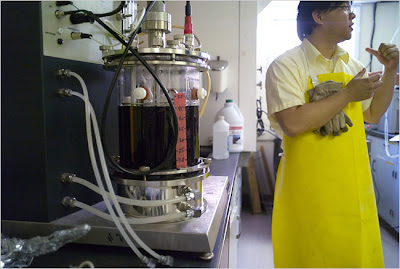
biofuel
Via: The New York Times
by HILLARY ROSNER

lunes, agosto 06, 2007

CO2: New technology would store carbon underground

Standing near an 800-meter-deep bore hole in the ground here, Frank Schilling picked up a fist-sized cylinder of sandstone and poured water onto its surface, watching the tiny stream skitter until it suddenly disappeared inside the rock's porous body.

The rapid absorption of the water , he said, showed how easily a much-less benign substance - carbon dioxide - could be stored once he and a team of researchers started pumping it into the half-mile-deep shaft.

"Everyone assumes we're going to store carbon dioxide inside of a cavern but the key is the tiny holes in this rock," said Schilling, a professor of mineral and rock physics. "We're going to press in the carbon dioxide and push out the salty water that's already there."

Schilling is spearheading a project near this small town about 20 kilometers, or 12 miles, west of Berlin that could change the way countries and industries store carbon dioxide, a fast-growing type of pollution, for generations to come.

Even as the drive to reduce greenhouse gases linked to global warming picks up, a number of countries are increasingly turning to coal as a major source of energy. The push for wide-scale development of coal that is quickly gaining in China is also growing steadily in some parts of Europe and the United States, forcing governments and businesses to consider how to dispense with carbon dioxide, a harmful side-product.

Several countries already bury carbon dioxide in sites off shore. At an undersea saline aquifer off Norway, Statoil buries carbon dioxide extracted from natural gas to avoid paying pollution taxes to the Norwegian government. Other projects involve oil fields, like those at Weyburn, Saskatchewan, where operators pump carbon dioxide back underground as part of efforts to extract hard-to-reach hydrocarbons in aging wells.

But existing oil and gas wells might only be able to accommodate a few decades worth of carbon dioxide. Offshore aquifers, even though they are vast, would require enormous lengths of pipeline to carry carbon dioxide out to sea.

"Putting CO2 offshore has the obvious advantage of public acceptability," said Jeff Chapman, chief executive of the Carbon Capture & Storage Association in London.

"But we know that there are centuries worth of space for storage onshore," he said, citing examples of promising sites in China, Germany, Poland and the United States.

Schilling's three-year experiment, called CO2Sink, makes Ketzin an important test of whether carbon dioxide might safely and durably be buried inland, where underground storage space could be almost endless. It involves pumping 100 tons of the gas each day into the sandstone beneath this flat Brandenburg countryside and monitoring the ecosystem for adverse results.

If the carbon dioxide stays put, as Schilling expects, that would give a major boost to carbon capture and sequestration, or CCS, an emerging technology that would allow industries based on fossil fuels to meet stringent emissions requirements - and stay in business for decades.

"I won't say it's not dangerous, but it's less dangerous than people think," Schilling said. Ketzin, he added, could be "writing a piece of history."

Shell, Vattenfall, E.ON, Statoil and RWE are contributing money and expertise to the project, which is overseen by the National Research Center for Geosciences in Germany, Schilling said. But he said that the bulk of total financing, about €30 million, or $41.5 million, comes from the European Union and Germany, which is heavily dependent on burning coal for its electricity and where the government faces widespread opposition to nuclear power, the main alternative to coal.

Some environmentalists favor the technology because it might be the only way to control carbon dioxide emissions at a time when developing countries like China are burning ever-greater amounts of coal to fuel their booming economies.

"The growth of coal plants is absolutely scary," said Sanjeev Kumar, a carbon emissions expert with the environmental group WWF in Brussels. "If we can make fossil fuels as green as we can, then we should try to get carbon capture and storage to work on a global level."

EU policy makers still are considering whether to make it mandatory for all new coal plants to incorporate the new, cleaner technologies after 2020.

That is not fast enough for Kumar, who is lobbying for an immediate moratorium on new coal plants in Europe unless they are constructed so that carbon dioxide technology can be incorporated as soon as it becomes available.

But a number of environmentalists are concerned that further development of the technology for commercial use will simply encourage industries and governments to rely more heavily on coal. They argue that funding should be channeled into the development of renewable energies rather than on prolonging the use of fossil fuels and accumulating vast amounts of underground waste.

"You've got to consider the load on future generations to take care of these storage sites," said Gabriela von Goerne, a climate campaigner for Greenpeace in Germany. "We believe this technology does not solve our problems at all."

Environmentalists said they were also skeptical that the new technology made underground carbon dioxide storage secure. One potential hazard is that concentrated carbon dioxide is heavier than air. Large quantities of escaped gas have, in the past, settled in low-lying areas with tragic results.

In 1986, about 1,800 people were suffocated at Lake Nyos, Cameroon, when a massive cloud of carbon dioxide escaped from the formerly volcanic site. Environmentalists have warned of similar dangers if leakages occur and gas settles in dips and valleys, where people live.

Leaks from carefully selected storage sites, properly monitored, would not carry those same risks, backers of the technology say.

"If CO2 ever does get to the surface, it's not going to be in our lifetimes or much of our near-descendants' lifetimes," said Chapman of Carbon Capture & Storage Association.

At the CO2Sink project, Schilling said he expected only about 1 percent of the 60,000 tons of carbon that is to be buried at Ketzin over the next three years to escape over the next century, and about at most 5 percent over the next millennium - amounts he said would be benign.

Any leaks would be most likely to occur at the bore hole, but around-the-clock monitoring would ensure problems are quickly fixed, he said. The carbon dioxide used in the experiment will be provided by Linde, which provides gas for carbonated beverages.

But people who live in and around Ketzin are worried about having carbon dioxide stored directly underneath their feet. The latest effort to bury gas in the neighborhood reminds many residents of environmental sacrifices already made in the name of industrial progress. During the mid-1960s, leaks of carbon monoxide from a former underground gas storage site at Ketzin required the permanent evacuation of a nearby village, Knoblauch.

"They already have a garbage factory in Ketzin and now this as well," said Beatrice Görtz, 35, who lives with her toddler, Mia, in Neu Falkenrehde, a hamlet two kilometers from the injection site. "I can't imagine that it's positive."

Among experts, there are growing concerns that public opinion could turn against the technology in the same way it did against nuclear power and genetically modified foods.

David Reiner, a lecturer in technology policy at Judge Business School at Cambridge University who has coordinated public opinion polls on carbon storage in six countries, said that if the public remained in the dark about the way carbon storage was supposed to work, there was no way of knowing how they would react to wide-scale development.

"Many people have an initial negative impression," he said, "although once they learn more we tend to see a more positive inclination."

Standing near an 800-meter-deep bore hole in the ground here, Frank Schilling picked up a fist-sized cylinder of sandstone and poured water onto its surface, watching the tiny stream skitter until it suddenly disappeared inside the rock's porous body.  The rapid absorption of the water , he said, showed how easily a much-less benign substance - carbon dioxide - could be stored once he and a team of researchers started pumping it into the half-mile-deep shaft.


Via: International Herald Tribune
by
James Kanter
,,,,,,,,,,,,,,,,


Found this post useful? Consider subscribing to
.


viernes, julio 27, 2007

REPORT: A Strategic Research Agenda for Photovoltaic Solar Energy Technology. European Photovoltaic Technology Platform

This Strategic Research Agenda (SRA) was prepared by the Science, Technology and
Applications Group of the EU PV Technology Platform, based on thorough consultations with representatives of research, industry and other stakeholders.

The members of the Working Group are experts in PV technology, working as senior researchers in the public and private sector. Feedback obtained in the public consultation on the first draft of this report following the 2006 General Assembly of the Platform has been discussed and taken into account as far as the Working Group considered this justified.

Although the group has attempted to cover all the most important parts of PV science, technology and applications and to address all the most important research topics, the reader may find some aspects insufficiently treated. Comments are, therefore, welcome through the PV Technology Platform secretariat (www.eupvplatform.org).

This Strategic Research Agenda will be updated as required in order to reflect developments in the photovoltaic solar energy (PV) sector.


DESCARGA GRATIS / TO FREE DOWNLOAD -->
REPORT: A Strategic Research Agenda for Photovoltaic Solar Energy Technology. European Photovoltaic Technology Platform


Blogalaxia :


martes, julio 10, 2007

CALIFORNIA: The biggest solar farm of teh World is planned in AMERICA

A San Francisco company said Friday it plans to build the world's largest solar power farm near Fresno, California.

The 80-megawatt farm is to occupy as much as 640 acres (260 hectares) and upon completion in 2011 will be 17 times the size of the largest U.S. solar farm, said Cleantech America LLC, a privately held 2-year-old company.

The farm will also be about seven times the size of the world's biggest plant and double the largest planned farm, both in Germany.

Bill Barnes, CEO of Cleantech, said the scale of the Kings River Conservation District Community Choice Solar Farm will change renewable energy and make California the global leader for huge solar projects and replace Germany as the solar energy hub of the world.

"We're pretty confident that solar farms on this scale are going to have an industry-changing impact," Barnes said by telephone on Friday. "We think it's the wave of the future. This scale of project, I think, creates a tipping point for renewable energy."

Barnes declined to give the estimated construction cost of the Community Choice farm.

"We think the impact for it will be similar to the impact of the computer chip," which gained computing power once made on a large scale, Barnes said.

"So too will economies of scale like the Community Choice farm drive down the cost of solar," Barnes said.

Cleantech has announced two solar farms so far and the future projects it will announce are, as of now, to be in California and also in the range of the 80-megawatt farm near Fresno, Barnes said.

Cleantech will partner with public agency California Construction Authority in building its projects.

Among the hurdles to be crossed before the new farm can be built, said Barnes, is buying the acreage somewhere in the San Joaquin Valley, hooking the farm to transmission lines, and contracting with a manufacturer of photovoltaic solar panels.

Cleantech plans to sell the solar-generated power -- enough for almost 21,000 homes -- to the Kings River Conservation District, which is a public agency that seeks to supply power generation for 12 cities and two counties in California's Central Valley.

Kings River is the water management arm of the San Joaquin Valley Power Authority, which was formed in November in order to purchase and generate enough power for the 12 cities and two counties to replace power now bought from investor-owned utilities Pacific Gas and Electric Co. a unit of PG&E Corp. and Southern California Edison, a unit of Edison International.

Last week, Cleantech announced plans to build a five-megawatt solar farm on 40 acres near Mendota, California, also in the Central Valley. Power will be delivered to PG&E.

The biggest solar farm now in operation is the 4.6-megawatt Springerville Generating Station near Tucson, Arizona which delivers power to Tucson Electric Power, a subsidiary of UniSource Energy Corp..

The Community Choice farm will not need state approval because Kings River is a self-generator and the farm is a renewable resource and does not emit pollution, Barnes said. But that designation must be approved by the California Energy Commission. Local permits must be given, he added.


Via: REUTERS
by Bernie Woodall

domingo, junio 17, 2007

TECH: What Killed Micro Fuel Cells? What is Next?

About four or five years ago, micro fuel cells were quite a hot topic in cleantech. They were going to power our laptops, cell phones, PDAs, blackberries, hand held multimedia devices, etc.

The story ran like this:

The digital age and increasing customer demand for more power hungry features like bandwidth, multimedia, et al on mobile devices like laptops, PDAs and cellphones mean the increase in power requirements are outstripping the pace of technology of lithium ion battery - therefore the only solutions will be micro fuel cells. And since battery manufacturers are a plodding, unimaginative lot, silicon valley and smart scientists can build a company to leapfrog them.

We saw major players like Motorola (MOT), Toshiba (TOSBF), Intel (INTC), and others taking a look, and startups like Smart Fuel Cells, Medis (MDTL) and MTI Micro seeking to make their name on a fuel cell the size of a credit card (or thereabouts) .

Today, still no micro fuel cell powered devices are on the market, many of the larger players have gone quiet, and all the startups are talking up battery charger (not device power pack) products - especially for the military and first responders.

What happened? What killed the micro fuel cells? Can they come back? And is something similar lurking around the corner for solar, electric vehicles, biofuels, next generation batteries or one of today's other darlings of the cleantech sector that we can learn from?

Well . . . let's see:

The technology is actually hard - Micro fuel cell technology proved a harder nut to crack than everyone thought (at least at anywhere near the same cost point) - and the product development issues given the state of the technology proved to be a real challenge.

Rational expectations - Market reaction to the underlying drivers has been aggressive. We've got global warming and high energy prices making people like Sun Microsystems, Inc. (SUN), Dell (DELL), and others hell bent on designing power saving devices - which the consumer is now interested in buying as a premium product. Once the electronic product companies actually put their minds to reducing power usage - well, it turned out that you actually CAN optimize a device to save power, and still pack enough features in to sell product.

The incumbent technology - Despite high profile thermal issues, the incumbent lithium ion technology turned out not to be so bad, and has continued to keep pace (as far as we lowly consumers can tell) - Bottom line: I now carry two very small four-hour battery packs for my laptop - I can last a transocean flight without needing to plug in.

Infrastructure, infrastructure, infrastructure - And yes, having to make infrastructure changes is very costly in anything energy-esque, whether its in fuel, entrenched distribution, or tooling. As usual, winning technologies in energy tend to be owned by businesses that find a way to work with existing infrastructure, not to try and replace it.

And in the end, the batteries (and the big battery makers) still rule the roost, for now.

SeekingAlpha
by Neal Dikeman

miércoles, mayo 23, 2007

TECH: La energía solar es capaz de convertir al CO2 en combustible

La posibilidad de aprovechar la luz solar para reducir el calentamiento global no es ninguna novedad. Lo interesante es aprovecharla para transformar un gas de efecto invernadero en un producto que sea útil.

Este invento, que todavía es un prototipo, divide el dióxido de carbono en monóxido de carbono (CO) y oxígeno.

El trabajo fue desarrollado por los científicos Clifford Kubiak y Aaron Sathrum, de la Universidad de California en San Diego.

Como su dispositivo no está optimizado aún, necesitan suministrarle energía adicional para que el proceso funcione.

Sin embargo, esperan que sus resultados atraigan la atención sobre el prometedor método.

Al separar el CO2, se genera CO, un importante producto químico industrial que se produce a partir del gas natural.

De manera que al separar el dióxido de carbono es posible ahorrar combustible, producir un producto químico útil y reducir la presencia de un gas con efecto invernadero.

Aunque el monóxido de carbono es venenoso, tiene algunos usos. Cada año es empleado para fabricar productos químicos de diverso tipo, como combustible.

Pero la tecnología de conversión del monóxido de carbono en combustible líquido ha estado disponible desde antes.

Fue inventada en Alemania en la década de 1920. Estados Unidos estuvo interesado en esa tecnología durante la crisis energética de los años 70, pero al terminar la crisis perdió el interés.

Hoy se ha cerrado el círculo porque los crecientes precios del petróleo hacen económicamente competitivo convertir el CO en combustible.

El dispositivo para dividir el dióxido de carbono utiliza un semiconductor y dos capas delgadas de catalizadores. Por el momento, el aparato está a prueba.

¿Cómo funciona el dispositivo?

El dispositivo, creado por un grupo de investigadores, captura los fotones, las partículas que componen la luz, generadas por energía solar mediante el semiconductor. El segundo paso es la conversión de energía luminosa en energía eléctrica por el semiconductor. El tercer paso es la aplicación de la energía eléctrica a los catalizadores. Estos últimos convierten, a su vez, el dióxido de carbono en monóxido de carbono en un lado del dispositivo y en oxígeno en el otro lado.

En la actualidad, la Universidad de California, en San Diego, donde se diseñó este prototipo, lidera los estudios químicos para frenar el calentamiento global. El desarollo de este nuevo dispositivo tardó más de un año.


Blogalaxia Tags:


domingo, mayo 20, 2007

BIOENERGY: The genetically-modified plants break down their own cellulose, making it possible to use waste biomass to produce ethanol

by Kevin Bullis

Researchers have genetically engineered transgenic corn plants that produce enzymes that can turn their leaves and stems into sugar by breaking down cellulose. The plants could lower the cost of creating ethanol from these sources, making such biofuel more competitive with that produced from corn kernels, the primary source of ethanol in the United States today.

Cellulosic sources of ethanol, such as waste biomass and switchgrass, are attractive because they are cheap and abundant. But converting cellulose, a complex carbohydrate, into sugars that can be fermented to make ethanol is more expensive than converting the starch in corn grain into sugar: breaking down the cellulose typically requires expensive enzymes extracted from genetically engineered microbes.

Now Mariam Sticklen, professor of crop and soil science at Michigan State University, and her colleagues have genetically engineered corn to produce the same enzyme that the transgenic microbes produce. The plant-grown cellulase could save about 30 to 50 cents per gallon of ethanol produced, Sticklen says.

Key to Sticklen's advance was engineering the corn so that the enzymes would not break down cellulose while the plants were still alive. Part of the solution was to use an enzyme found in bacteria that live in hot springs. The enzyme is only active at high temperatures--higher than those that a plant's cells would reach while it is alive. As a result, the enzyme remains dormant until it is heated to about 50 ºC.

Sticklen's transgenic corn is "one of several promising approaches to address the central obstacle impeding establishment of a cellulosic-biofuels industry: the absence of low-cost technology to overcome the recalcitrance of cellulosic biomass," says Lee Lynd, professor of engineering and biology at Dartmouth College, in Hanover, NH. But he adds that in-plant production of enzymes comes with its own challenges.

One of these challenges, according to James McMillan, a principal group manager at the National Renewable Energy Laboratory, in Golden, CO, is ensuring that the transgenic plants don't have negative environmental effects. For example, if plant matter containing these enzymes was left in the field, it could change ecosystems by making sugar more readily available to microorganisms.


Cheaper, Cleaner Ethanol from Biotech Corn

If the researchers are able to overcome some of these challenges, the biotech corn could lead to more-efficient production of ethanol, starting by making better use of corn kernels. Much of the corn kernel contains cellulose that isn't converted into ethanol in conventional ethanol plants. Some developers are considering adding equipment to existing ethanol plants for processing this corn-grain cellulose. In Sticklen's transgenic corn, this cellulose in the kernel would contain enzymes for converting cellulose into sugar, which could simplify the process.


Blogalaxia Tags:


Label Cloud

The Energy Blog