sábado, diciembre 15, 2007

CLIMATE CHANGE: Consigue conferencia de Bali un acuerdo final

La Conferencia de la ONU sobre Cambio Climático que se celebra en la isla de Bali (Indonesia) alcanzó hoy un acuerdo final, después de que Estados Unidos cediera a las demandas de los países pobres.

El consenso abre el camino para negociar un nuevo acuerdo sobre cambio climático más ambicioso que sustituya al Protocolo de Kioto.


Via: El Universal
Found this post useful? Consider subscribing to
.

lunes, diciembre 03, 2007

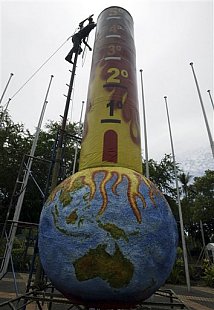
CLIMATE CHANGE: United Nations Kicks Off Global Warming Conference to Build New Climate Agreement

Faced with melting polar ice caps and worsening droughts, climate experts at a massive United Nations conference Monday urged quick action toward a new international pact stemming an increasingly destructive rise in world temperatures.

A key goal of the two-week conference, which opened with delegates from nearly 190 countries in attendance, will be to draw a skeptical United States into an agreement to cut emissions of carbon dioxide and other so-called greenhouse gases.

While the U.S. delegation declared it would not be a "roadblock" to a new agreement, Washington remains opposed to steps many other countries support, such as mandatory emissions cuts by rich nations and a target for limiting the rise in global temperatures.

The American position suffered a blow Monday when the new Australian prime minister signed papers to ratify the Kyoto Protocol climate pact. The move leaves the U.S. the world's top emitter of greenhouse gases as the sole industrial power not to have joined.

Conference leaders urged delegates to move quickly to combat climate change.

"The eyes of the world are upon you. There is a huge responsibility for Bali to deliver," said Yvo de Boer, the executive secretary of the conference. "The world now expects a quantum leap forward."

The conference kicked off amid growing global momentum for dramatic action to stop rising temperatures that scientists say could lead to swamping of coastal areas and islands by higher oceans, the wiping out of species, economic havoc and a spike in natural disasters such as storms, fires and droughts.

The Bali meeting will be the first major conference of its kind since former Vice President Al Gore due to arrive next week and a
United Nations scientific council won the Nobel Peace Prize in October for their environmental work.

The immediate aim will be to launch negotiations toward a pact to replace the Kyoto Protocol when it expires in 2012, and set an agenda for the talks and a deadline. The
United Nations says such an agreement should be concluded by 2009 in order to have a system in place in time.

Among the most contentious issues ahead will be whether emission cuts should be mandatory or voluntary. Also to be tackled will be to what extent up-and-coming economies like China and India will have to rein in their skyrocketing emissions, and how to help the world's poorest countries adapt to a worsening climate. The American delegation was clearly on the defensive in Bali, presenting a statement detailing the ways the U.S. is fighting global warming without submitting to mandatory emissions targets.

"We're not here to be a roadblock," insisted Harlan L. Watson, the senior U.S. climate negotiator. "We're committed to a successful conclusion, and we're going to work very constructively to make that happen."

Confronted with the scientific reports of the past year, the Bush administration has signaled a willingness to play a larger role in the negotiations, and U.N. officials agree they must craft a post-Kyoto framework that Washington will go along with. Australia abandoned the anti-Kyoto alliance with the U.S. on Monday, when new Prime Minister Kevin Rudd signed the paperwork to ratify the pact. Delegates in Bali erupted in applause when Australia's delegate, Howard Bamsey, told the plenary that Canberra was jumping on board. Environmentalists at the conference cited what they saw as growing international momentum for tougher safeguards against global warming.

Even critics of the Bush administration pointed out that many individual states, such as California, were on the forefront of cutting emissions.
"Despite the failure of the current president to take serious action on global warming, the political landscape in the United States is shifting dramatically in favor of mandatory limits on global warming pollution," said Alden Meyer of the Union of Concerned Scientists, citing upcoming action in the U.S. Congress. Trying to fend off charges that America is not doing enough, Bush said last week a final Energy Department report showed U.S. emissions of carbon dioxide, a leading greenhouse gas, declined by 1.5 percent last year while the economy grew.


Via: Associated Press|JOSEPH COLEMAN
Found this post useful? Consider subscribing to
.


viernes, noviembre 30, 2007

ESPAÑA: El cambio de focos en 500 semáforos logrará un ahorro energético del 90 por 100

Manuel Torres LaveagaEn España en la localidad de Logroño, se ha emprendido dentro de una de las iniciativas de su Plan de Eficiencia Energética, un programa para sustituir los focos empleados en casi 500 semáforos de la ciudad.

Los que se emplearan en adelante serán de tecnología de iluminación LED, alcanzando a cubrir unas 3400 lamparas que componen los antes mencionados semáforos. El ciclo de vida de la iluminación LED es diez veces superior a la ahora iluminación tradicional que es sustituida. Esta sustitución de bombillas costará 60.000 euros, que se pagarán con una subvención del Instituto para la Diversificación y el Ahorro de la Energía de España, que volverá a solicitarse los próximos años.

Programas de este tipo debemos de darle cierto seguimiento, durante el periodo suficiente que nos permitan valorar que resultados están arrojando y compararlo con lo estimado. De esa forma poder emprender este tipo de iniciativas con mayor agilidad y seguridad de que realmente se consigue cierta ( y que tanta) eficiencia energética.


Via: La Rioja | by Manuel Torres Laveaga


Tags: fotolog|||, ,

Found this post useful? Consider subscribing to
.


domingo, noviembre 25, 2007

UGANDA: Energy for Rural Transformation Project


The Energy for Rural Transformation Project is in support of the First Phase of the Energy for Rural Transformation Program. The purpose of the long-term program is to develop Uganda's rural energy and information/communication technologies (ICT) sectors so as to bring about rural transformation. The central objective of the first phase is to put in place "on-the-ground" a functioning conducive environment and related capacity for commercially oriented, sustainable service delivery of rural/renewable energy and ICTs.

The project consists of four components, of which three will be implemented by the private sector.
  1. The main grid related power distribution and generation component will finance investments in presently unserved rural areas that will be connected to the main grid. It will also provide Global Environment Facility (GEF) grants for qualifying renewable energy investments.
  2. The second component will support independent grid systems that may require some transmission as well as smaller systems.
  3. The third component will be implemented by private companies who will market, sell, and install PV products and provide after sales services. It will finance GEF grants for installing solar PV systems in homes, public health, educational and water institutions, and selected rural enterprises.
  4. The cross-sectoral linkages component will be implemented by the Ministries of Health, Agriculture, Education, and Water for such sectors
Via: WorldBank
Found this post useful? Consider subscribing to
.

Label Cloud

The Energy Blog